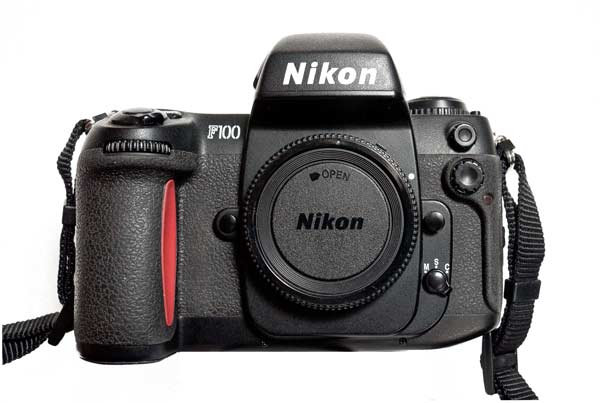

Some people are Nikon fans. Some people are Canon fans. I was drawn to Nikon and I have owned four Nikon film cameras in the years I have been taking photographs. I had an FE and then an F90x, and then an FM2n. Now I have an F100.
The FE and the FM2n are manual focus cameras and very simple to use. You put the film in, set the film speed, and shoot.
With the FM2n, you have to frame the subject and then change the aperture or speed until the meter in the viewfinder tells you that the exposure is correct.
The FE makes life a bit easier for you with a semi-automatic setting in Aperture Priority.
The F90x is an autofocus camera, and pretty straightforward to use.
I sold the FE when I got the F90x.
Then I sold the F90x when I stopped shooting film.
I bought the FMn2 much more recently – when I decided to start shooting film again.
Except I didn’t shoot any film with the FMn2 except a test roll to make sure it worked OK before I sold it on.
Recently however, with the move to live in Edinburgh, I have access to the darkroom at Stills – Scotland’s Centre For Photograpy, which is located here in Edinburgh.
I plan to write more about Stills in a subsequent post. For now though I want to talk about the F100.
It is an autofocus camera and a completely different beast to the other cameras I owned.
The Story So Far
I have shot just one roll of film with it so far, and I used my Nikon 105mm f2 DC lens.
The 105mm Nikon is a heavy, metal lens, very sharp, and top of the range in its day.
The ‘DC’ stands for ‘defocus control’ which means that you can change the degree of fall-off of the out-of-focus areas. The attractiveness or otherwise of the fall-off is called bokeh, and if you google for it, you’ll find lots of discussions about it.
Leave a Reply to David BennettCancel reply