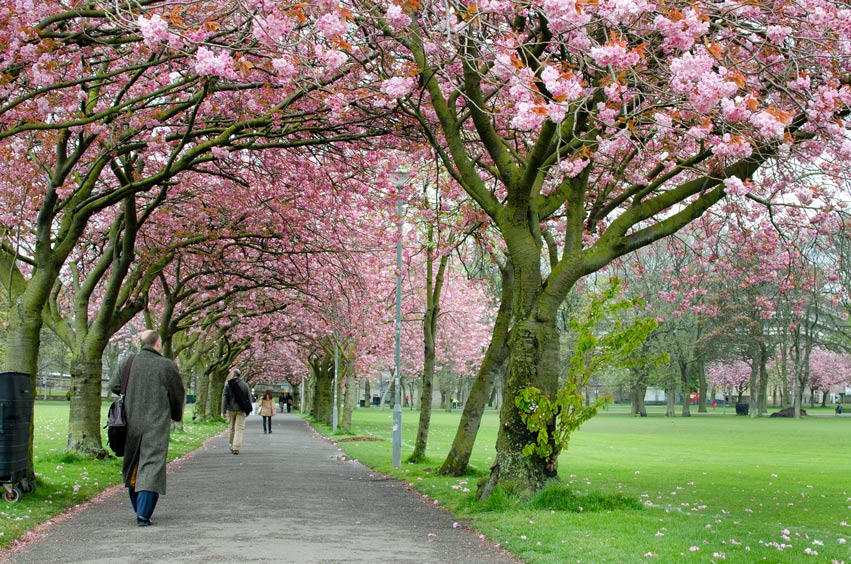
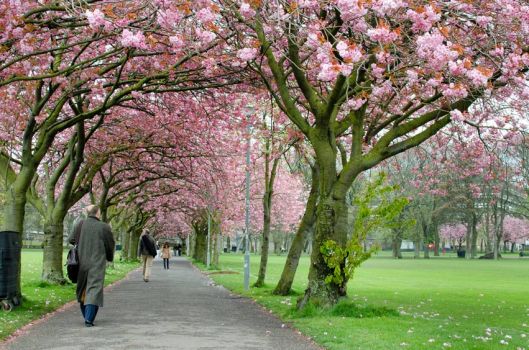
These trees in blossom are on Jawbone Walk in the Meadows in Edinburgh, just a few hundred yards from the city center.
And the reason that the footpath is called Jawbone Walk is that at the Melville Drive end of the footpath there are four whale’s jawbones up-ended and joined at the top to make an arch.
I pass through the arch most days and the first time I did so I noticed the metal bands around the posts, inscribed with mention of The Faire Isles and Zetland and the Edinburgh Exhibition of 1888.
For a while I thought the arch may be made of wood, but then I examined it more closely and it seemed to be made of bone.
I’ll photograph it and put the photos up here when I can.
The Royal Commission on Ancient and Historical Records in Scotland, which looks after Scotland’s national collection of buildings, archeology, and industry describes the jawbones in this way:
Notes: Four whale jawbones placed vertically on a rough square and meeting at the top (held with metal strut), to form arch at start of pathway across the Meadows. Circular cobbled area on ground within the arch.
Exhibited at the Edinburgh Exhibition of 1886 where the Orkney and Fair Isles Knitters’ Stall was constructed of the jaw bones.
Erected at the entrance to the east and west Meadows from the Middle Walk in 1887, after the Town Council of Edinburgh received a letter from Sheriff Thomas recommending the acceptance of the jawbones.
Inscriptions : On each of four bronze bands around bones approximately 90cm off ground (incised and shaded lettering cast in the bronze): FROM ZETLAND & FAIR ISLE KNITTING STAND / EDINBURGH EXHIBITION 1886
Signatures : None
Design period : 1886
Year of unveiling : 1887
Information from Public Monuments and Sculpture Association (PMSA Work Ref : EDIN0065)
Do you find it easy or impenetrable to imagine the state of mind and the culture in 1887 that would want to erect four jawbones at the entrance to a walk through the grassy meadows?

Leave a reply to Seba Silver Cancel reply