Check back at the end of this review for continuing updates – latest update (always at the end of this review) January 25 February 5February 21
PENCILS

I like the Nikon P5100. Here’s why.
The Nikon D200 is too big and heavy to lug around wherever I go -particularly with anything other than the 50mm lens on it.
I tried using a Nikon D40 as an alternative for walking around when I was not specifically out shooting, but it was too big to ignore and stick in my pocket, and so good that I debated selling the D200 and keeping the D40.
In the end it was the bigger file size, the flash control, the dedicated buttons, the better strength and balance with longer lenses, and features like that that made me decide to keep the D200 and sell the D40.
So now I was back where I was before the D40 but this time I decided to get something I could stick in my pocket.
LION AT WHIPSNADE ZOO

To backtrack a bit, the size of the sensor on the D40 or D200 means that image quality is as good at 800ISO as it is at 100ISO on a small sensor compact. That was why I bought the D40 in the first place rather than buying a compact.
But now I knew I really did want something small because otherwise I was simply not going to have a camera with me at all times. So I looked at the sample images on DP Review and other review sites and narrowed the choice down to the Nikon P5100, the Canon G9, and the Fuji F50fd.
In case anyone is going to say that online samples are no way to judge images, DP Review in particular has some nice big files you can look at.
MILLENIUM DOME IN LONDON
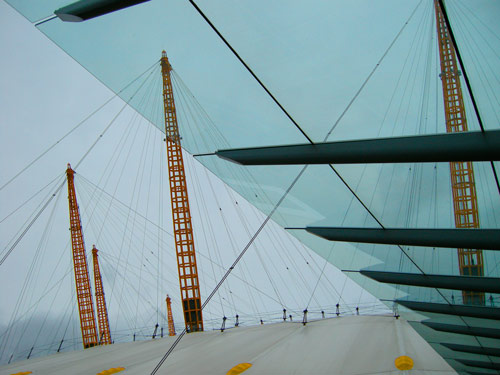
The review sites seem to agree that the Fuji and the Canon had the best image quality in terms of absolute sharpness and that the Nikon can produce nice realistic, naturalistic, film-like colors. From looking at the samples I felt that the difference in image quality between the three cameras was small within certain parameters. For the Nikon that means not shooting at high ISO. Realistically I don’t think there is any compact on the market that can produce good files at high ISO.
Of course the Canon can shoot RAW and that allows more tweaking than a jpeg allows, but I wanted to leave my tweaking to the shots from the D200 and try to get a good result straight from the camera with the little Nikon.
Of course there are those who prefer to shoot jpegs all the time, even with DSLRs that shoot RAW. Ken Rockwell is a good proponent of this view. And by the way, he is crazy about the vivid, well processed jpeg images he is getting out of the Nikon D300 – in contrast (pun?) to the comparatively flat shots he gets out the D200.
CAFE LIFE
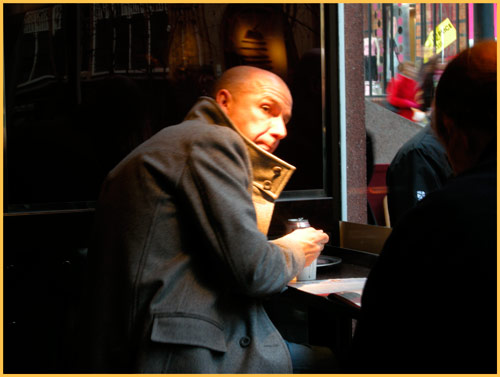
And while we are talking about punchy images, I often find with RAW images from the D200, that one way to process them is to do everything in Camera Raw and then open the image as a PSD. Then duplicate the image and change blending mode to ‘Multiply’ and adjust the opacity. There is a point somewhere along the scale where the image is not too dark, and yet has more punch than the straight image.
I digress.
The other downside of the Nikon is its poor focusing in low light. In fact I had already wondered and worried about the low-light focusing ability of the Nikon P5100 from my experience with the Nikon P2 – a camera I have had for a couple of years. The P2 is dreadful in low light. It hunts and hunts but it does not find its target. Even with a good target it is not that quick. Thankfully the P5100 is better, but it is not as quick as the Fuji. I tried out the Fuji in a shop, shooting with the assistance of a salesman, into the darkened recess of a cupboard. It focused without hesitation.
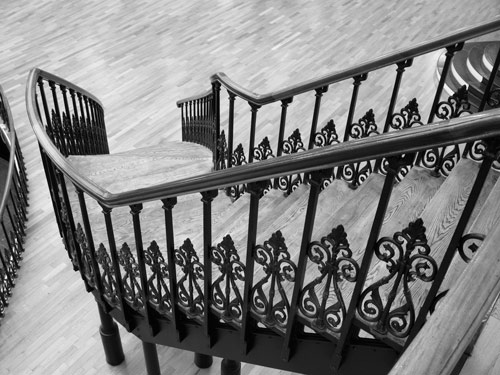
THE CEILING OF THE BRITISH MUSEUM

One thing I have noticed about the P5100 is that it focuses more easily in poor light when it is at a shorter focal length.
So what are the positives that leaned me towards the P5100?
-
It has 12MP, which means that if it did take a good shot, the file will enable me to print big.
It has a viewfinder, which the Fuji does not.
It is a lot lighter and a bit smaller than the Canon.
It has a grip on the right hand side that makes it very stable and secure to hold – even with one hand.
It is very easy to change ISO, exposure compensation, aperture (I usually shoot in Aperture Priority mode), flash, and focus range (close up, normal, and distant).
So I bought the Nikon and noticed that it fitted in the case I had bought for the P2, and that it is more or less the same weight as the P2 and not much bigger – just nicer to use.
It does focus more slowly than I would like, so it is not a camera for speedy grab shooting. Not that it is terrible.
So what can it do?
I prefer images to speak for themselves and these are a selection of shots over the past few days. All shot at ISO 64 or 100.
MORE – UPDATES – ADDITIONAL – EXTRA
January 21
White Balance
During the time I have been using the camera I have found little treats that make it even more enjoyable to use. For example, setting white balance manually. This is how it is done.
In ‘shooting’ mode (as opposed to ‘playback’ mode), pressing the menu button brings up the menu options.
One of these options is White balance.
A right click on the four-way controller brings up the choices (Auto, Daylight Incandescent, etc.). One of these choises is ‘Preset manual’.
Click that and the lens zooms out (a bit of a surprise the first time that happened – so watch where you put your fingers) and two options appear. These options are ‘Cancel’ and ‘Measure’.
Click the ‘OK’ button on ‘Measure’ and the camera takes a shot of whatever it is pointing at, and sets white balance.
This description may sound like setting white balance manually is a long and complicated process, but it is not. And what is more important, it does a very good job of setting white balance.
January 23
Vibration Reduction
I haven’t mentioned the VR – vibration reduction – and that’s because I haven’t decided yet exactly how good it is.
Wwhen you look through the viewfinder of a DSLR with a VR lens, you see the image rocking about until you half-press the shutter and then you see it snap into a steady position. It is a wonderfully pleasant experience.
Holding a compact camera at arms’ length to compose an image in the LCD is not the best way to hold a camera steady or the best way to see whether the image is steadying in the LCD. And peeping through the tiny viewfinder means you are (a) not looking through the lens so you don’t see the effect of VR, and (b) even if you were, the image is so small you couldn’t possibly see the effect of VR.
The only way to test how good VR is, is to look at a lot of photographs. I don’t mean ones that are taken in ‘test conditions’ to test VR, but ones that are taken in real conditions.
Taking test shots to test sharpness, or noise at high ISO, for example, is a different matter. Sharpness or lack of it, and noise or lack of it, are either there or not there. So it is perfectly valid to test. But with image stabilization, it is a question of what works in the real world and as of now, I haven’t formed a definite opinion. I think it works down to about 1/15th of a second, but I need more time to check.
January 25
Buttons and Dials
First a word about the Nikon P2 I have owned and used for two years or so. The buttons and dials on the Nikon P2 work just as well as they did the day I bought the camera. Nothing has failed; but the dial on the top plate has always turned too easily. It occasionally happens in use, but more often when I pull the camera out of its soft case. Then I sometimes see this:
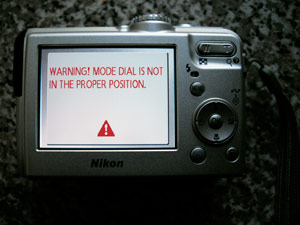
I am long-sighted so I need glasses to see the buttons and dials on a camera. And I would rather not have to fish in my pocket for my glasses in order to set the dial to ‘A’ (Aperture Priority) when I have just taken the camera out to use it.
The Nikon P5100 on the other hand has excellent buttons and dials. They feel reassuring to use; are very well-built, and don’t move unless you want them to.
Barrel Distortion
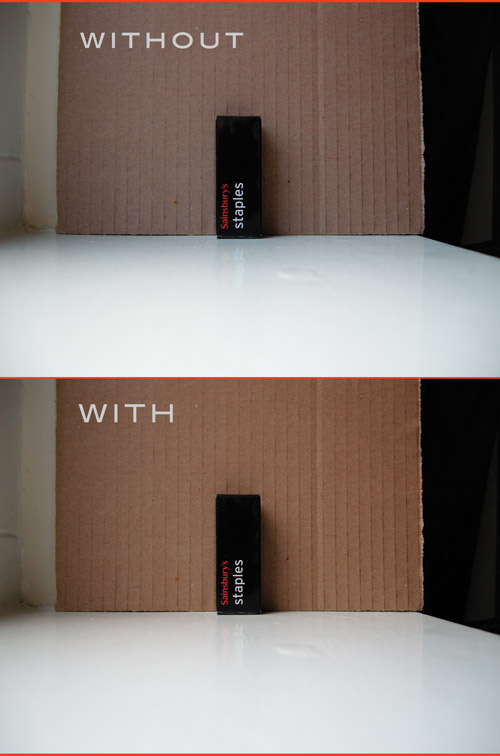
There is a lot of barrel distortion at the near end. But, and here is the good news, the camera has Distortion Control. This is enabled via the menu in Aperture Priority, Shutter Priority, Manual, and Program modes by just clicking on Distortion Control and activating it. It is a software lens correction for the specific lens, and it works very well to correct lens distortions.
The results of enabling Distortion Control can be seen it the LCD, so you know what you are going to shoot, rather than have the camera apply the control after you shoot.
Page 112 of the Manual states that enabling Distortion Control corrects distortion at the peripheries of the frame. It also states that enabling it reduces the size of the frame. The two shots here were taken from the same vantage point, so whatever reduction in the size of the frame there is, can be seen (or not) in the shot.
Camera to subject distance was about 40cm / 16inches
February 21
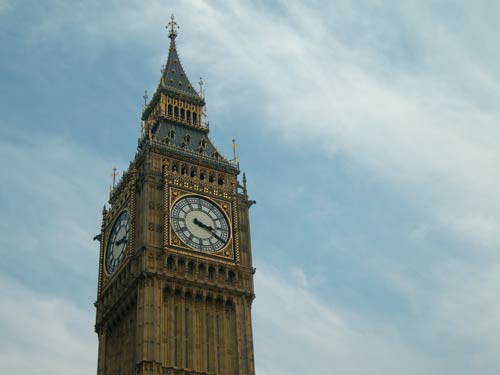
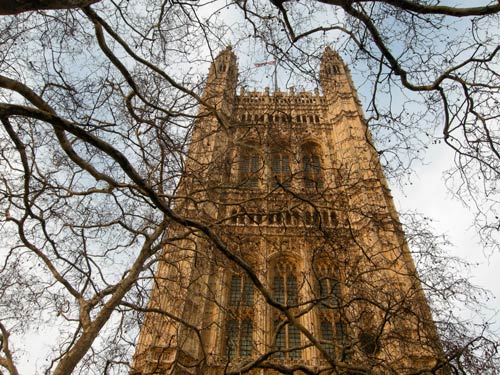
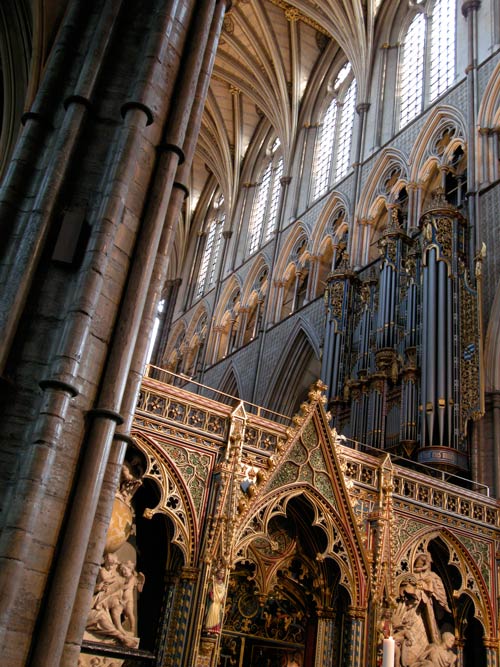
On a wander around the Houses of Parliament and Westminster Abbey, and standing at Piccadilly Circus London.
Big Ben Tower
The Tower at the west end of the Houses of Parliament
Westminster Abbey inside and out
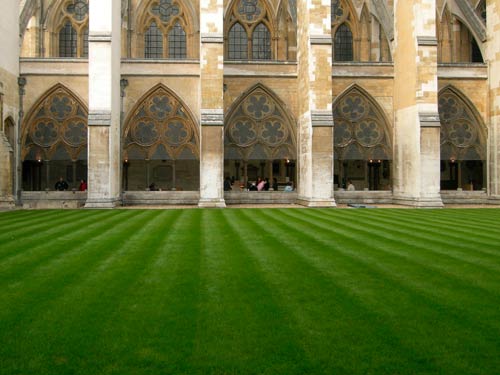
A crop of one of the people in the window in the Westminster Abbey shot

Piccadilly Circus
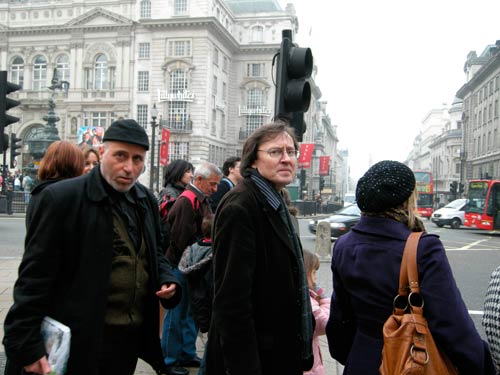
Crop