I shoot a Nikon D200 and which has more or less the same number of pixels as the D60. So it came as a big surprise when I put a card in the D60 to find that a card (it takes SD cards) will hold about 100 RAW shots per GigaByte, whereas the D200 will hold 60. And I guess this is because of the NEF compresson on the D60. There is no option to shoot uncompressed NEF on the D60.
The D200 shoots compressed as well as uncompressed NEFs and at this point I should walk into the other room and see whether I have it set to uncompressed or not, and whether the compression would account for the difference.
But I am not going to because I trust my memory and I am sure that there is not way the compressed or not, the D200 shoots 100 shots to the GigaByte.
OK, in the cause of scientific enquiry, I went and checked, and I’m right – the D200 shoots 60 shots to the GigaByte, whether the NEFs are compressed or not.
The question is whether the extra NEF compression on the D60 results in lower quality images? I have been using the D60 with two lenses – the 60mm macro G lens, and the 12-24mm. I bought the D60 as a kit with the 18-55mm lens but I don’t like it. It is not that I dislike the zoom range or the build quality or the image quality – I just don’t like the way the central part of the lens peeps out when one turns the focal length either way from its mid point.
Turn it down to 18mm or up to 55mm and the central part of the lens slides out and seems very fragile. It makes me nervous about catching it against something as I pass. Hence, I shall probably put it up for sale. But it is light and small, and given that a normal 50mm lens won’t ‘work’ on the D60 because it is not an AF-S lens, I should try the dinky little 18-55mm more. But before I take it out for an extended run, I have to check that its image quality really will hold up against the other two lenses.
I bought the D60 as a back-up to my D200. Since I bought the 70-200mm lens and put it on the D200, I haven’t taken it off. The camera and the lens are wedded to one another and both stare at me suspiciously if I come to near with an ‘I’m going to separate you’ look.
The good and the bad about the D60.
I think the dynamic range is less than on the D200 and it is really easy to blow highlights where the D200 would not. Perhaps it is the metering. I have always been very, very impressed with the metering on the D200, and yet I can crank the exposure compensation up into minus 2 with the D60 and still run into problems. So active D lighting is a necessity and it works. And it is easy to set. Just put your forefinger on the button on the top plate that is next to the shutter and just left of the exposure compensation button. And at the same time, turn the rear command dial one click and it turns Active D-Lighting on. Turn it again and it toggles Active D-Lighting off.
I say ‘rear’ command dial, but there is no front command dial. It’s force of habit from the D200. And that is one tiny niggle, and that is that I forget how to change things sometimes, and I find myself twirling a non existent dial.
ISO is easily changed by pressing the button to the left of the lens mount and turning the rear command dial.
The bad is that it will not autofocus except with AF-S lenses.
So do I like it? Overall, yes. It’s light and quick to use, which makes it suitable for its purpose as a back-up for when I do not want to lug around the D200. And with Active D-Lighting as a means to conquer blown highlights, it is capable of handling even high-contrast scenes.
And the D60 has become a more attractive proposition with the impending introduction of the AF-S 50mm f1.4.
Update regarding the 18-55mm lens
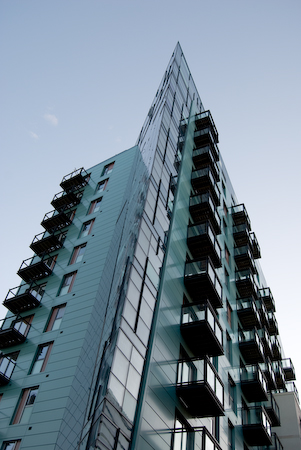
I have been using it and I’m not knocked out about it, but it’s OK. The following are shots I took with it on a trip to London, and one shot of a building in Leeds.
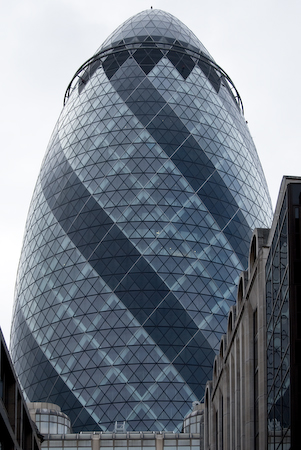
This building is in the financial and business area of London and is known as the Gherkin. That’s not its official name of course, which is the Swiss Re Building. It houses the City of London Mayor’s offices. It’s the first time I’ve seen it this close and my first impression is to wonder about the waste of space as the building becomes narrower towards the top. It is supposed to be buffeted less in the wind than a rectangular building would be. It stands on the site of the Baltic Exchange that was blown up by the IRA in 1992.
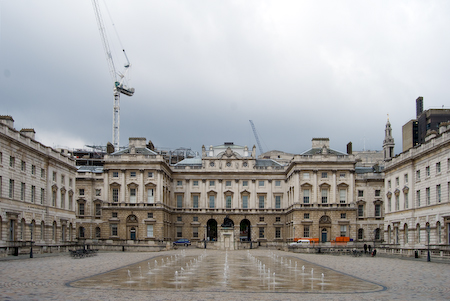
This is the courtyard of Somerset House looking towards the wing that houses the Courtauld Gallery. Apart from heading a huge textile and chemical company, Mr Courtauld had wonderful taste in paintings and the gallery is currently (as of the beginning of October 2008) holding an exhibition of Cezanne paintings and drawings. There is lots of other stuff there and it is a wonderful place to visit. Highly recommended.
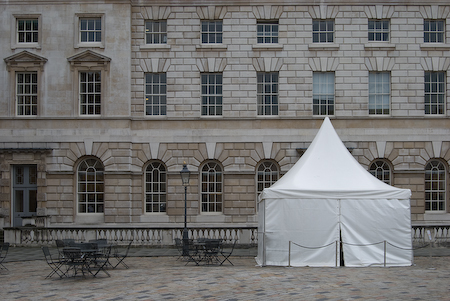
And here is an open-air cafe in the courtyard of Somerset House. The tent flap had not yet been drawn back and the tent reminded me of hussars and campaigns in India that must have been talked about by gentlemen walking across this courtyard two hundred years ago. (The present Somerset House was built in 1780).
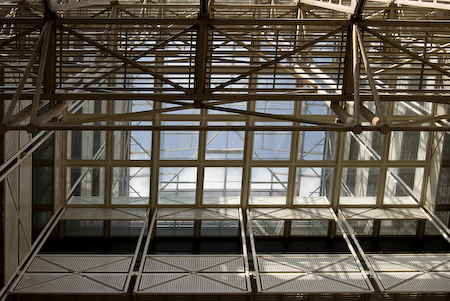
Looking up at a rare glimpse of sun in one of the walkways by the shops at Liverpool Street Station.
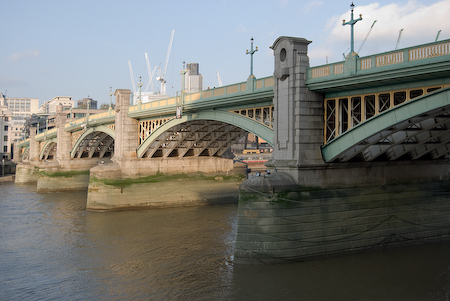
Southwark Bridge spanning the Thames by the Globe Theatre. It was the nearest bridge leading to St Paul’s cathedral before the building of the Millenium footbridge in the year 2000. Southwark Bridge is one down from Blackfriars Bridge, a place that makes me think of the very public display of contempt for the law that was shown by the hanging there of Roberto Calvi in 1982.
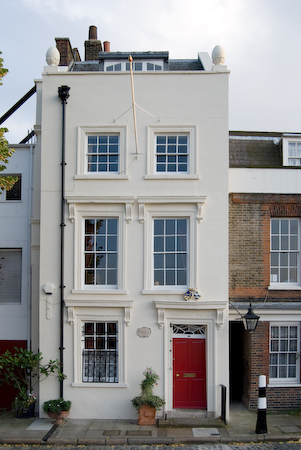
This building is by the Globe Theatre. It says “Cardinal’s Wharf” above the door, and the plaque on the wall to the left of the door says “Here lived Sir Christopher Wren during the building of St Paul’s cathedral. Here also in 1502, Catherine Infanta of Castille and Aragon afterwards first queen of Henry VIII, took shelter on her first landing in London.”
And this is a building still being built in Leeds, by the river Wharfe.