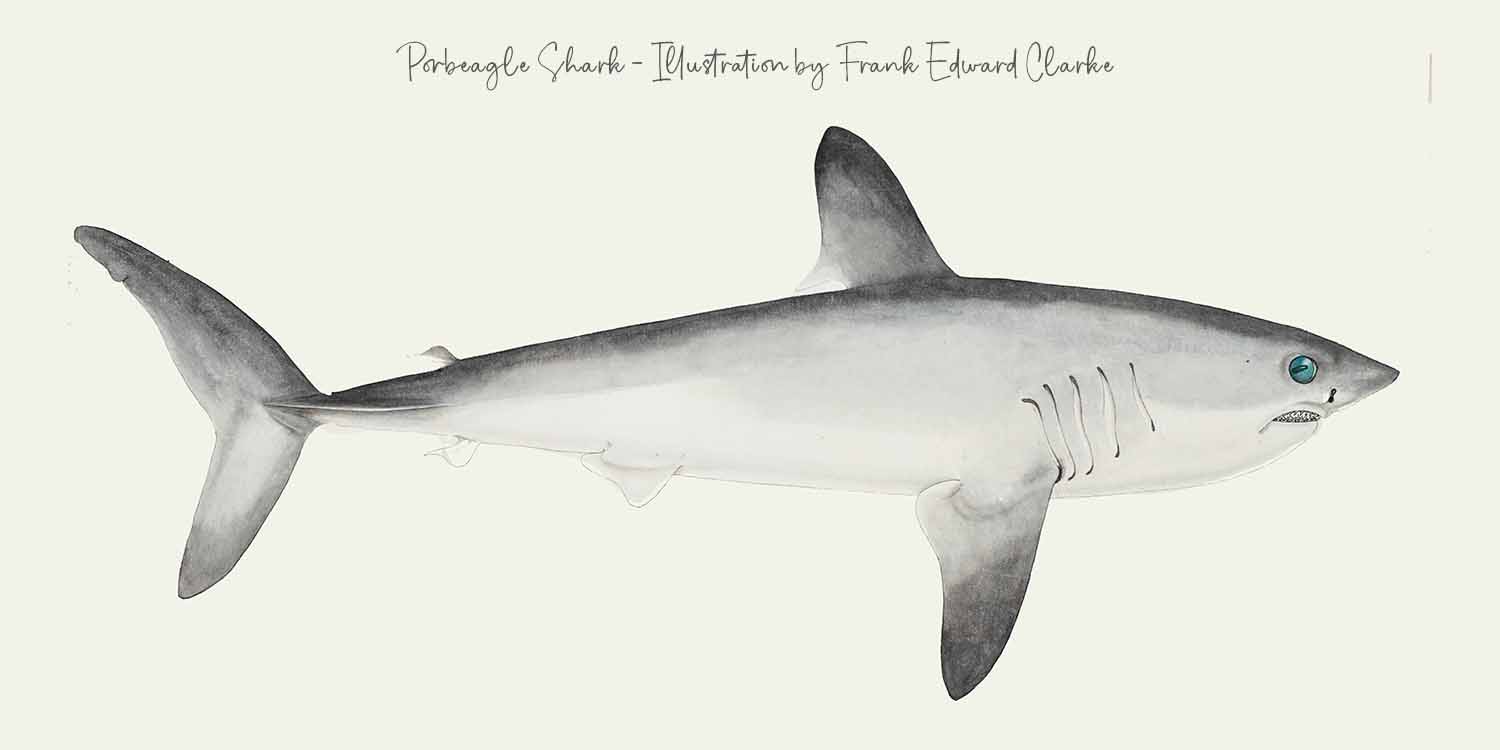
Porbeagle Shark – Illustration by Frank Edward Clarke 1877
The theme of World Animal Day in 2022 was ‘a shared planet’. For 2023 the theme is ‘Great or Small, Love Them All’
Well, some animals are downright dangerous to humans, even if they themselves are unaware of how dangerous they are – rats and fleas that carry diseases, for example.
So love them at a distance and make sure they don’t invade our lives. That’s becoming more difficult to do as humans invade more habitats and climate change alters the distribution of, for example, the mosquito that spreads Dengue fever and the ticks the spread Lyme disease.
But for those animals that attack or defend themselves knowing that they are doing so, let’s talk about sharks.
Talking About Sharks
There are more than 500 known species – from ones that are15cm (6 inches) long, to ones that are over 12m (40 feet) long.
They’ been around for 400 million years, compared to the 200 million years since dinosaurs first arrived.
Some Greenland sharks (Somniosus microcephalus) living today are thought to be between 270 and 520 years old. That would mean some of them were alive in the 1500s.
And if that doesn’t float your boat – consider the depths at which they are found. The Frilled shark is home at around 1200 metres deep. The Goblin shark at 1300 metres; the Sixgill shark at 1750 metres deep; the Greenland shark at 2150 metres; the Cookiecutter shark at over 3500 metres; And now we are getting way beyond the depth at which light can penetrate. It is cold down there. But the Megamouth shark is found at over 4500 metres.
What else? Sharks don’t have a bony skeleton. They have a cartilaginous skeleton, which makes them lighter, more bendy, and therefore more agile.
They continuously lose and replace their several rows of teeth,
Some species can smell a drop of blood in the water from several miles away.
They have a senses called the ampullae of Lorenzini, with which they can detect the weak electrical fields in the muscles and nerves of their prey.
All of that sounds like they are the perfect killing machine for killing humans, except that shark attacks on humans are extremely rare.
Sharks do not actively seek out humans as prey; humans are not a primary food source.
Most sharks’ diets consist of fish, seals, sea lions, marine mammals, or smaller marine creatures.
And as apex predators they are hugely important in maintaining the health and balance of ocean ecosystems.
So given that humans behave as though they can do pretty much what they want with the planet, even if there are consequences down the line – you can probably guess how humans treat sharks. But do you know about shark finning?
Shark Finning
Shark finning means catching a shark, cutting off its fins and dumping the still-living shark back into the ocean, where without their fins, they are unable to swim and they die.
It is difficult to be sure of the exact number of sharks that have their fins cut of because it is often done illegally and goes unreported.
However, estimates suggest that tens of millions of sharks are killed each year for their fins.
This is pushing some shark species to extinction.
Shark Fin Soup
Shark finning is driven by the demand for shark fin soup – mostly in Asian countries.
So great or small, love them all – or at least don’t cut their bloody fins off and dump the animals back in the water.
And all just to make shark’s fin soup, which is by all accounts tasteless – as Gordon Ramsey describes.
Google ‘Gordon Ramsey’ and ‘shark finning’ and watch his YouTube videos on the dangers of tracking shark finning gangs, and what the tasteless soup tastes like.
Sharks In UK Waters
Before I looked up which sharks visit UK waters, I would have guessed Britain sees maybe two or three species. In fact it’s a lot more as you can see from this list.
And in case you thought like I did that only smaller sharks come to UK waters, the Basking shark, the first on the list can be ten metres (thirty-three feet) long, .
Basking shark
Shortfin mako shark
Blue shark
Porbeagle
Spiny dogfish
Spurdogs
School shark
Speckled smooth-hound
Greenland shark
Thresher sharks
Smooth hammerhead
Squatina squatina
Oceanic whitetip shark
Bramble shark
Common thresher
Angular roughshark
Kitefin shark
Small-spotted catshark
Nursehound
Leafscale gulper shark
Blacktip shark
Portuguese dogfish
Knifetooth dogfish
Blackmouth catshark
Mouse catshark
Birdbeak dogfish
Black dogfish
Longnose velvet dogfish
Smalltooth sand tiger
Starry smooth-hound
Sharpnose sevengill shark
Common smooth-hound
Bigeye thresher
Copper shark
Longfin mako shark
Dusky shark
Silky shark

Leave a comment