
I was walking around Fitzrovia in Central London, when I came to Fitzroy Square. From a distance I could see there was something going on – a cluster of people looking at something.
The cluster of people were onlookers watching the filming of Ammonite, about Mary Anning.
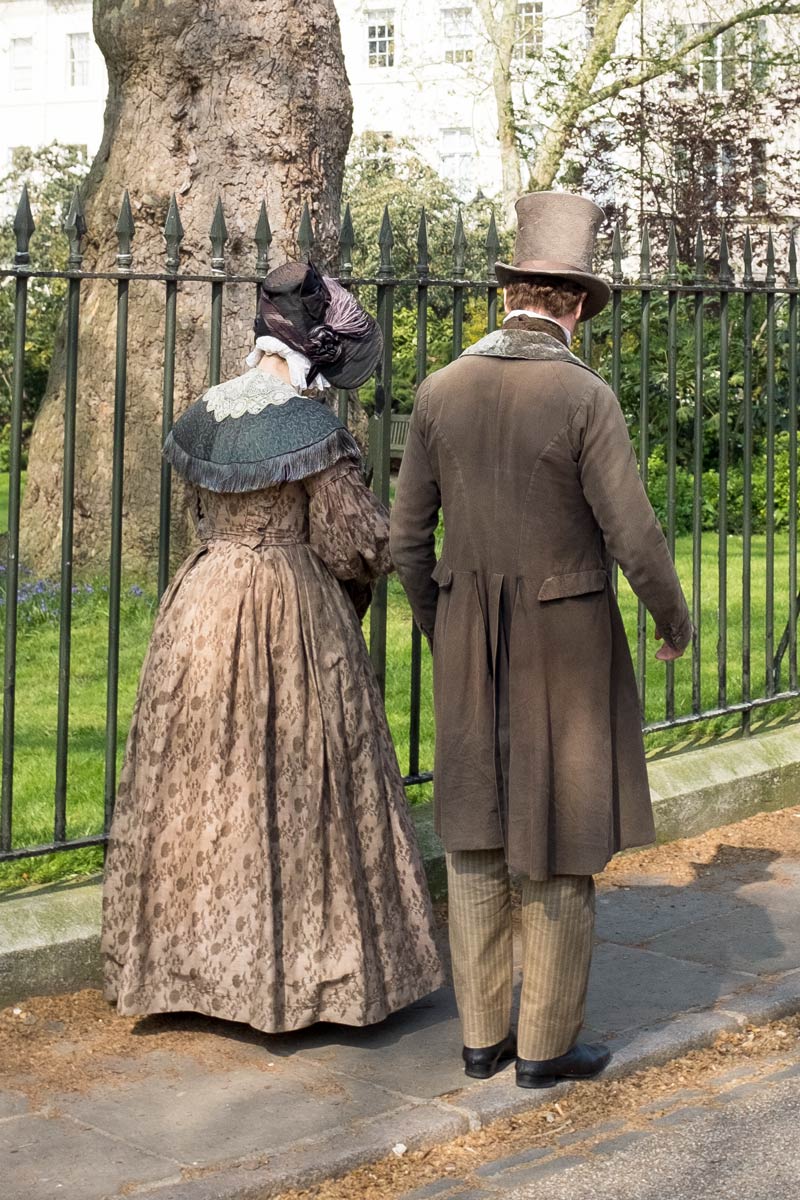
With a bit of framing to cut out the modern bits, I got a shot I liked.
The couple were waiting for their cue to start moving for the shooting of the scene. The film crew shot the scene twice while I was there, and it was very interesting to watch people moving this way and that within the confines of the film camera’s view of the scene.
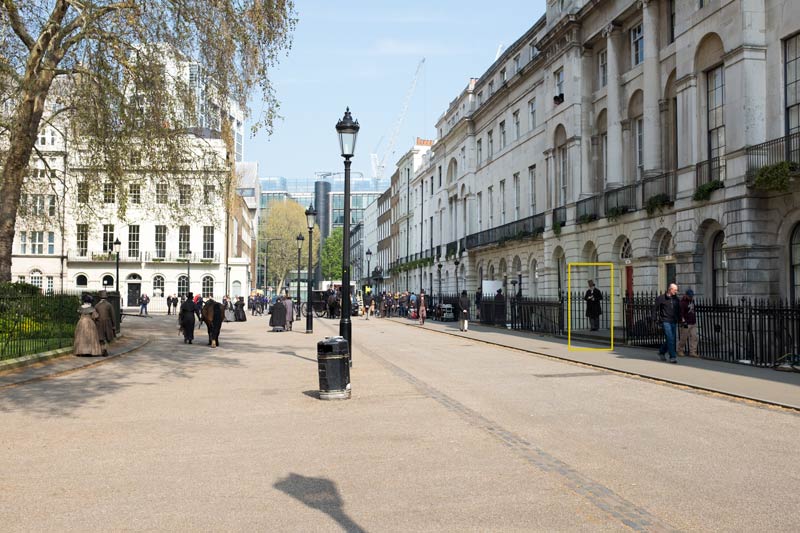
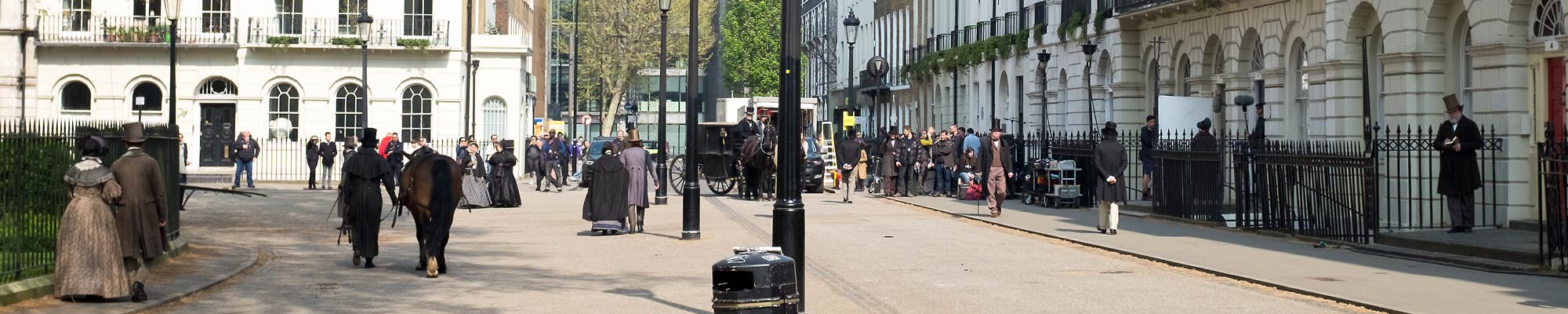
I’ve marked a rectangle in yellow around the man standing at the entrance to one of the buildings on the right. When the scene gets underway, he starts walking up the street towards us.
Watching him do it twice was surreal.
Here’s a closeup – and you can click it for a larger version.
The film is slated to be shown in 2020, and Variety magazine describes it as follows:
The story is set in 1840s England, when Anning and a young woman sent to convalesce by the sea develop an intense relationship, altering both of their lives forever. Anning is credited with making key scientific discoveries in the Jurassic marine fossil beds in the cliffs along the English Channel.
An article in the Telegraph quotes Barbara Anning, a relative of Mary Anning now living, who believes that
“…if Mary Anning was gay she should be portrayed as gay and this should also be by a gay actress. But I do not believe there is any evidence to back up portraying her as a gay woman… I believe Mary Anning was abused because she was poor, uneducated and a woman. Is that not enough?
“Do the film-makers have to resort to using unconfirmed aspects to somebody’s sexuality to make an already remarkable story sensational? Imagine the shame and embarrassment this woman would be feeling right now to actually have her private sex life discussed and played out on screen. This adds nothing to her story.”
Why Mary Anning Deserves To Be Famous
Mary Anning is famous today for having found the skeleton of an ichthyosaur embedded in the rock on the beach at Lyme Regis is Dorset. She found it in 1811, when she was twelve, and spent months painstakingly separating it out from the rock.
This was nearly fifty years before Darwin published The Origin Of Species, so the idea of species extinct for millions of years was novel and, maybe for most people, unimaginable.
The ichthyosaur lived around 200 million years ago and Mary Anning’s find was more than five metres (16 feet) long – so all the more difficult for people at the time to accept as a prehistoric fossil.
The ichthyosaur specimen is now in the Natural History Museum in London.
Things got more complicated when Mary discovered a complete skeleton of a Plesiosaurus, and later found a part skeleton of a Pterodactyl. She was accused of fakery; her finds were later published by others without crediting her; and she was refused recognition in her lifetime for the dedicated scientist she was.
By the way, Lyme Regis is especially rich in ammonites, hence the name of the film.
Go Feed The Horses
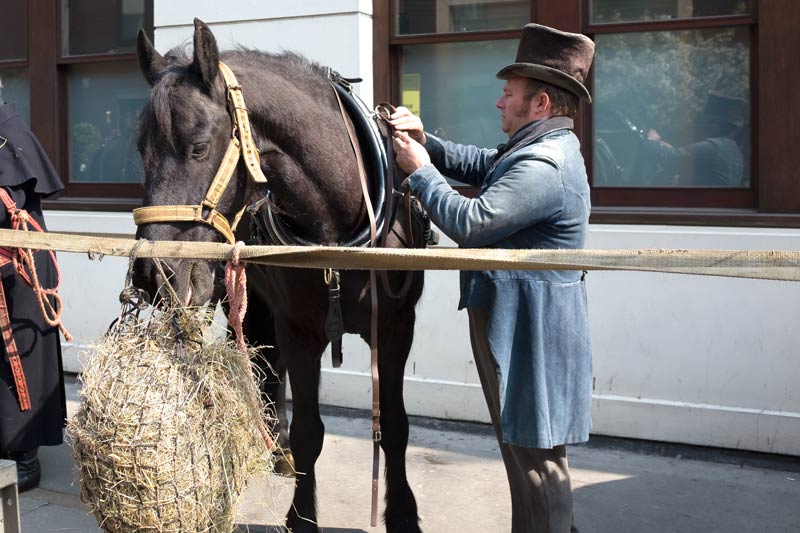
When I was walking back later in the direction of the Square I spotted some men in costume leading away the horses that had been in the scene. They stopped on a side street where the horse box was, and soon the horses were tucking in to hay.
The horses were adorable, the way they were pulling the hay out of the netting hay bags.

The Couple Close Up

Leave a comment