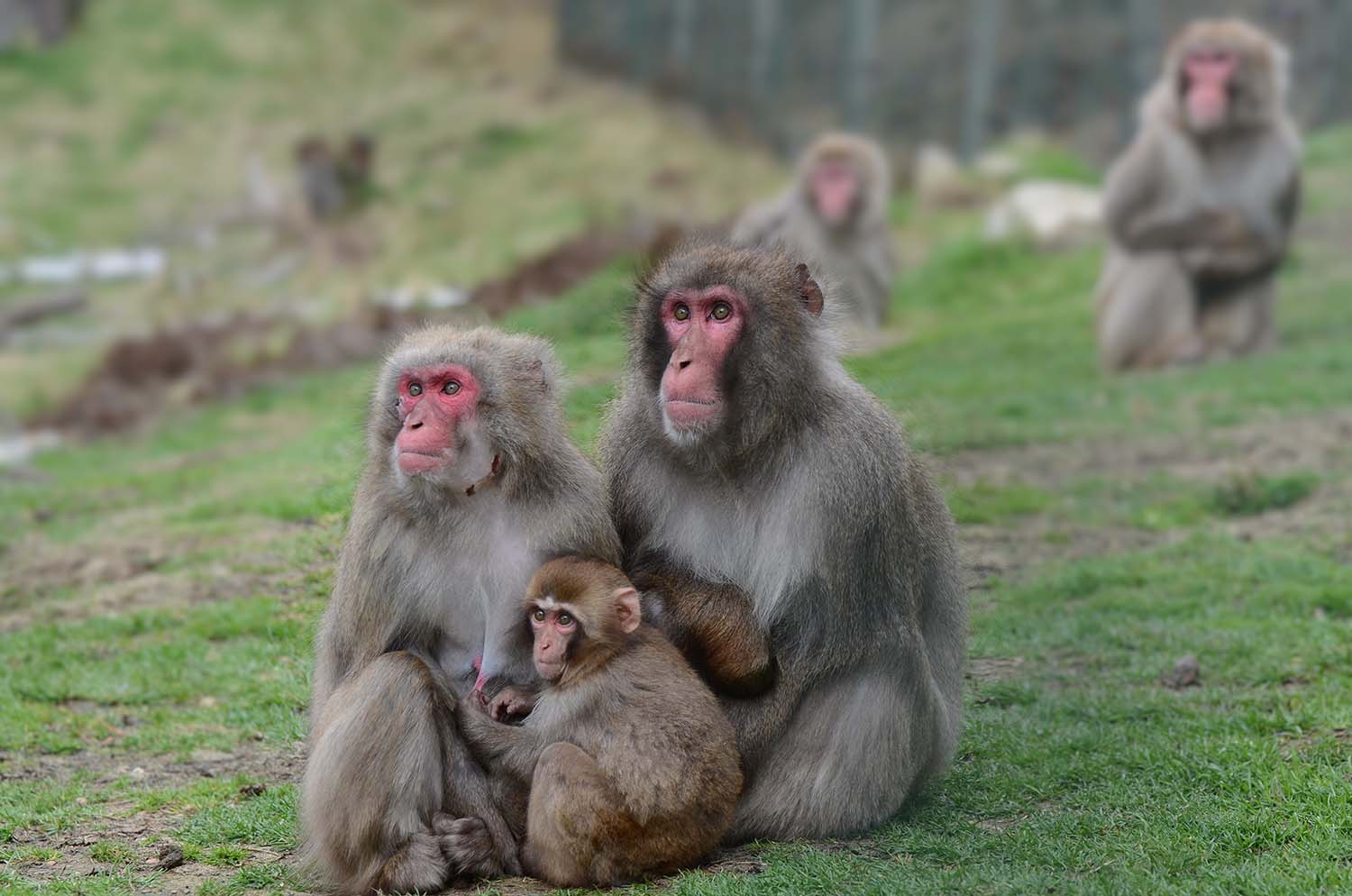
I was looking through some old files and came across these Japanese macaques, also known as snow monkeys.
I photographed at the Cairngorm Wildlife Reserve in 2014. I mistakenly shot JPEG rather than RAW, which doesn’t bring the best out of the camera and lens. I shot with a Nikon D7000 and 70-300mm f4,.5 – f5.6 Nikon lens at 95mm. That’s equivalent to a 142mm lens on full frame. The EXIF data says I shot at f5.6 at 1/500th second and ISO 400.
The reason I am putting them up here is that I find time and time again that cameras and lenses that I grew dissatisfied with turn out later have been perfectly OK.
Memo to self to stop searching for bigger and better?
I wonder at what these Japanese macaques were looking so intently?
Each macaque, it seems, has a different expression and a different attitude to whatever it is they are looking at.
When you compare the resolution of different sensor sizes, the first thing to understand is that resolution is a linear measure, not an area measure.
What matters for actual recorded detail is how many pixels you have along the long edge of the sensor, because that determines how much fine structure you can sample across any line in the scene.
A full-frame sensor is 1.5 to 1.6 times longer than an APS-C sensor on its long edge. For Canon cameras it is 1.6, and I am going to stick with them.
So if the pixel density is the same, it will have 1.6 times more pixels in that dimension and therefore 1.6 times more detail.
The increase in sensor area between APS-C and full frame is about 2.6 times, but area does not directly give more resolution. It simply allows more total photons into the system, which helps with noise and dynamic range. I explain why below.
This leads to the next question. Which is better – a high-megapixel APS-C sensor or a lower-megapixel full-frame sensor?
In pure detail terms, the APS-C sensor with more total pixels can out-resolve the full-frame sensor even though the sensor itself is smaller.
Detail is done by pixels, not by square millimetres. But the small sensor will not match the larger one in noise performance, colour depth, tonal smoothness, or high-ISO behaviour because the individual pixels are smaller and therefore gather fewer photons.
So the trade-off is simple. If you are comparing a high-megapixel APS-C sensor with a lower-megapixel full-frame sensor, you get more detail from a higher megapixl APS-C sensor at base ISO. But you getter better overall image quality and low-light performance from a lower-megapixel full-frame sensor.
This naturally leads to the question of pixel size. Once pixels become very small, the light can only arrive at each photosite at increasingly oblique angles, especially toward the edges of the sensor.
Each pixel has a micro-lens to guide light into the photodiode. Imagine each micro-lens as a little pyramid with light striking the sloping sides.
The further you push pixel density, the harder it becomes for the micro-lens to channel light efficiently. Light hitting at a steep angle can miss the photodiode, reducing efficiency, causing colour shifts, increasing vignetting, or encouraging light to spill into neighbouring pixels. That spillover, called crosstalk, reduces fine detail and colour accuracy. Smaller pixels also have smaller wells for storing charge, so they saturate earlier and lose dynamic range. And because they sample the image more finely, diffraction becomes visible at wider apertures than before, limiting on what a lens can deliver.
As a side note, to help light strike more equally across the sensor the micro-lenses at the edges of a sensor are sometimes offset or tilted to help compensate for the fact that the light is not hitting squarely.
All these problems are governed not by the total megapixel count, but by the size of each pixel.
Pixel size is measured by pixel pitch, which is the distance from one pixel centre to the next. At today’s level of sensor technology, the meaningful lower limit for maintaining high image quality is around three microns.
Above three microns, engineers can maintain high efficiency, good control of crosstalk, generous full-well capacity, and good corner performance.
Below three microns, compromises start to outweigh gains unless you use extremely sophisticated sensor designs. You can still make such sensors, but each extra megapixel comes with a cost.
Translating this into MP, what is the number of pixels for a full-frame sensor beyond which each pixel will be below three microns?
The answer is about ninety-six megapixels.
At that resolution, a 36 × 24 mm sensor has a pixel pitch of about three microns.
The 61-megapixel Sony A7R V, for example, is well above that threshold with a pitch of about 3.76 microns, which is why its per-pixel quality remains strong.
But if manufacturers push full-frame beyond the 100-megapixel range, they will be operating below three microns and will need increasingly complex engineering to manage the optical and electrical compromises.
This is valuable information. It means that a person knows that a 61MP Sony A7R V, a 45.7MP Nikon Z7 II. a 45.7MP Nikon Z8, or a 45MP Canon EOS R5 Mark II are all going to perform well. The only downsides are weight. The Z7 II weighs 705g. The Canon EOS R5 Mark II weighs 745g. The Nikon Z8 weighs 910g. This starts to make the Sony A7R V look very attractive at 723g – more or less the same weight as 24MP cameras such as the Nikon Z6II and the Canon R6II.
Then There Is The Viewer
We know that more pixels mean you can crop more if you need to. But leaving cropping aside, what about normal viewing distance and the visual acuity of the human eye at normal viewing distance? In other words, if the viewer can’t see the difference, why ask for a camera with more megapixels?
Or to turn it the other way around and ask how big a print you can make from a given MP sensor.
When printing from a digital file, 300DPI is optimal, but depending on the normal viewing distance for that print, then but 150DPI may be indistinguishable from a more densely printed print. In other words, print bigger and the viewer stands further back.
Think of the Impressionist painters. Viewed from a distance our eyes put together the scene and make sense of it. Get close up and we can see the individual daubs of paint.
And then there’s the subject. Not all subjects are the same. We humans can ‘compose’ a face that fills the frame in a way we cannot with the myriad leaves on a tree. We can get away with a smaller megapixel count in photos of faces.
I shot the photo of trees at the top of this article with a Nikon D500 with a 35mm f1.8 lens. The D500 is a 20MP APS-C camera.
Even so, a 20MP sensor can print at nearly three feet across if it is printed at 150DPI. And if the viewing distance is say three metres, then even 60DPI will produce a good looking print. And at 50 metres then a very small 4DPI will be adequate. You only have to look at a poster on the side of a bus to know that is true. Looking from across the road it look fine. Close up it is just big dots.
And if we are talking about how things look on the screen, then DPI is irrelevant because it is the resolution of the screen that determines perceived quality.
The Future
A real revolution in the way micro lenses capture light might turn all these calculations on their head, just like all the revolutions of the past. It is just 50 years since the very first digital camera, and that had a resolution of 0.01 megapixels and the camera weighed five kilos.
Conclusion
If you have the money and can stand the weight then get a high MP full-frame camera. And get good lenses, because they too determine the quality of the light that reaches the micro-lenses and ultimately reaches the photosites.