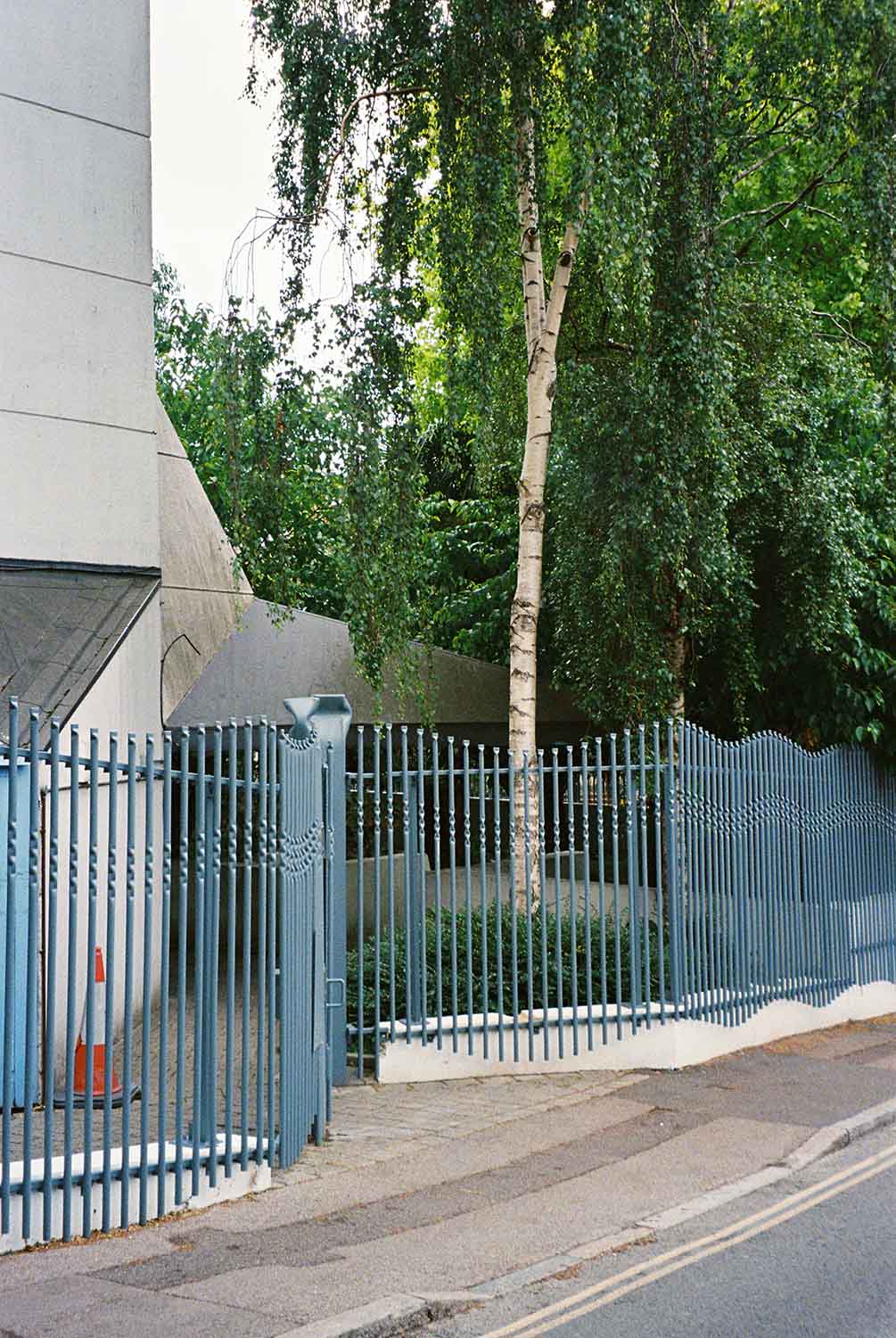
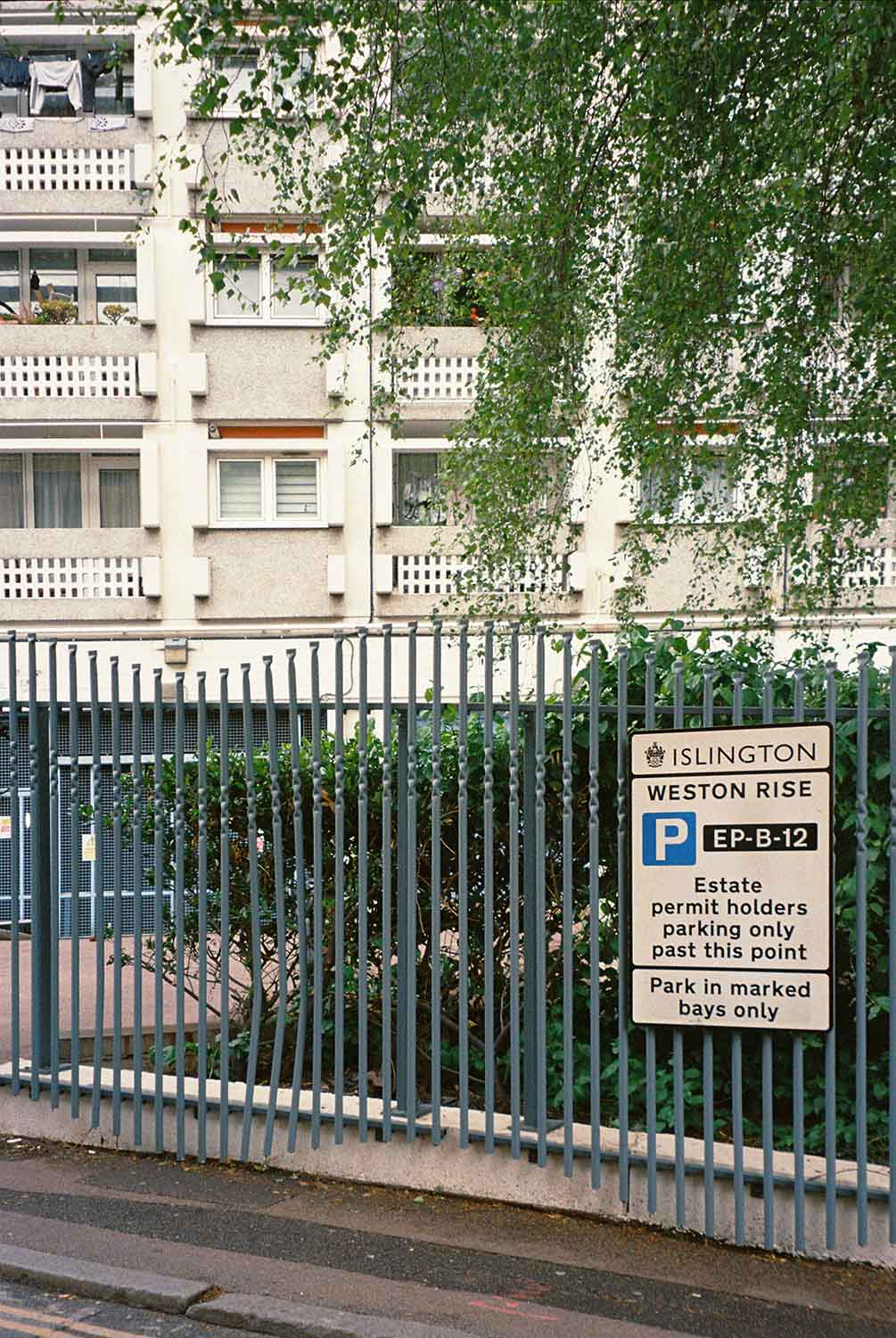
Here are a couple of photos I took on a photowalk where we were all shooting film cameras.
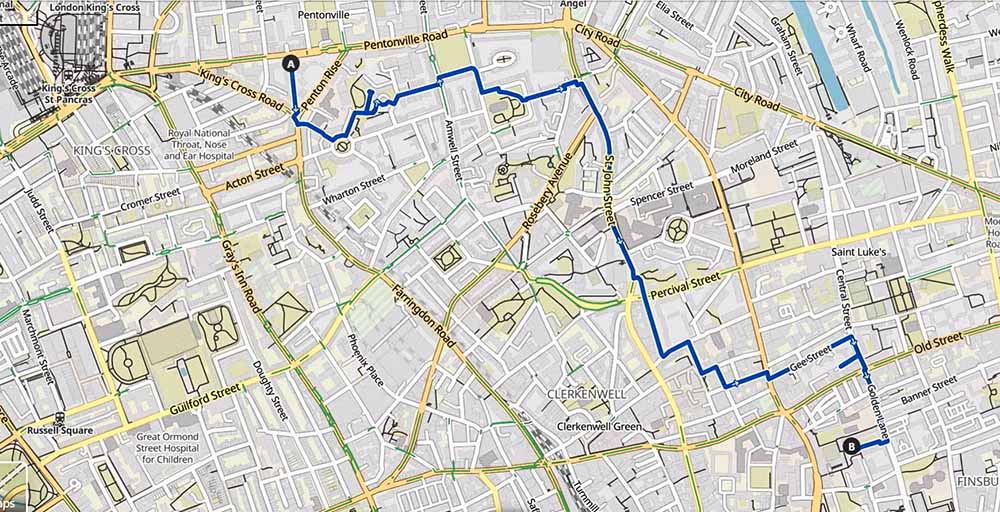
A photographer named Nick Ambrose led the walk and below are his notes with a map of the route around some of the estates in London. I am posting it here because if you live in London or visiting and you want to see what town planning meant in previous decades, here it is.
I guess some of the estates were started with pride and some as a dumping ground. That’s not unique to Britain of course.
Some of the estates we visited have fared better than others. To my eyes, some were doomed from the start.
I shot with Ilford Delta 400 B&W film on a Minolta Freedom Escort and with Kodak 400 colour film on a Nikon OneTouch 90.
Now I have the scans back, I see the photos are mostly rubbish, with just a couple of very average but at least reasonably well exposed images of the Weston Rise Estate,
I bought the Nikon under the pressure of being at Photographica, where everyone was either selling or buying or in the process of deciding.
Nick Ambrose’s Notes For The Walk
Weston Rise estate: Inspired by Sheffield’s Park Hill estate, the concrete forms of Weston Rise coil together as five interconnected blocks which were commissioned by Greater London Council and pushed the boundaries of high-density housing in the 1960s. Balconies and blocky protrusions give this building an interesting Brutalist facade.
Architect: Howell, Killick, Partridge & Amis
Date Built: 1967
Bevin Court: One of several modernist housing projects designed in the city in the immediate postwar period. Fusing his aesthetic concerns Lubetkin created a stunning constructivist staircase that forms the heart of the building. Well worth photographing if we can gain access. The building was given grade II* listed status in December 1998 and was restored by the London
Borough of Islington in 2014–2016.
Architect: Skinner, Bailey & Lubetkin,
Date Built: 1954
Spa Green estate: Noted as being the most complete post-war realisation of a 1930s radical plan for social regeneration through Modernist architecture. Conceived as public housing, it is now a mixed community of private owners and council tenants. In 1998 this work by the architect Berthold Lubetkin received a Grade II* listing for its architectural significance, and the major 2008 restoration brought back the original colour scheme, which recalls Lubetkin’s contacts with Russian Constructivism.
Architect: Tecton (which by the time of Spa Green’s completion in 1949 had regrouped as Skinner, Bailey & Lubetkin).
Date Built: 1949
Stafford Cripps Estate: The three 12-storey blocks of Stafford Cripps Estate, London’s very first high-rise housing project, have since been overshadowed by the towers that have sprung up around them. Designed by Joseph Emberton, then Chief Housing Architect for the Borough of Finsbury, the estate was built at a cost of £350,000 and its trio of towers, Cotswold Court, Parmoor Court and Sapperton Court, were at the time the highest flats in the country. Named after the Labour Party politician Sir Richard Stafford Cripps (1889-1952), the ‘Y”-shaped tessellating blocks made the most of a particularly snug site. Their striking white balconies make the structures feel dynamic and exciting.
Architect: Joseph Emberton
Date Built: 1956
Golden Lane Estate: A primary-coloured precursor to the Barbican’s next-door concrete utopia, Golden Lane Estate is the earliest work of architects Chamberlin, Powel & Bon. The trio were lecturers at Kingston Polytechnic when they each submitted designs for the estate to a competition hosted by the Corporation of London that intended to reinvigorate a bombed-out plot of land. The 557 homes were designed for single occupants and couples. Despite each home’s limited footprint, the architects’ interiors revolutionised small-space living, with sliding screens and vaulted spaces, and the estate’s nine blocks achieved Grade l-listed status in 1997.
Date Built: 1953-62
Architects: Chamberlin, Powell & Bon
The Route Of The Walk

Leave a comment