
I’ve had my Fuji X-T50 with 35mm f2 lens for nearly six months, and I know enough about its handling now to review it.
The body weighs 438g, which is light considering that it has IBIS and a 40MP sensor.
And overall I am very pleased with the camera. It doesn’t feel too small in the hand, and controls are very straightforward.
It hasn’t taken me long to feel I can instantly make any settings I need to aperture, shutter speed, ISO, and exposure compensation without having to sit and remember. The viewfinder shows an icon against each setting to remind you.
The only thing I forget momentarily is that the lens itself has an aperture dial, so that is where I need to turn the aperture ring to change aperture.
It’s simple, but there are so many lenses now that do not have an aperture right, that it is easy to forget , if only for a moment.
The IBIS (in-body-image-stabilisation) works very well and I am very happy with the extra megapixels. My experience is that more megapixels really does improve image quality.
General Points About APS-C Versus Full Frame
Compared to full-frame cameras with the same settings, APS-C cameras have more in focus because there’s more depth of field because there’s a shorter focal length for the same angle of view.
There are plus points and minus points for that compared to full frame.
Were I to want a shallow depth of field – for portraiture for example – then I would need a lens with a bigger maximum aperture than if I was shooting full frame.
The focal length and maximum aperture I would need in APS-C to get the same depth of field a full frame sensor with a 50mm f2 lens is a 35mm f1.4 lens. And they are available.
And the focal length and maximum aperture I would need in APS-C to get the same depth of field a full frame sensor with a 35mm f2 lens would be a 23mm f1.4 lens. And they too are available.
It’s the same with a full frame 85 mm f2 lens. A 56 mm f1.4 APS-C lens would give the same depth of field.
So getting a shallow depth of field with an APS-C camera is completely doable.
Of course, if I had a full frame f1.4 full lens and wanted an APS-C lens with the same depth of field, then we are getting into very wide aperture lenses and they come at a big premium.
Outside of that, the counter argument is that APS-C lenses have more depth of field for the same f-stop, and for work where more depth of field is wanted – such as in landscapes – then APS-C has the advantage.
Downsides with the X-T50
So, is there anything not perfect about the camera?
It comes down to weight and ease of carry. My Ricoh GR III in a leather carry case slips into a jacket pocket and it weighs so little that I truly can forget I have it with me. That is not so with the XT-50.
It is not that it is heavy; it is that it is not so light and small that I can forget it. So then the question arises as to whether it is the right size. Specifically, is it big enough to handle a long lens. And it is not, not really.
I also have a 55-200mm lens, and the body feels too small to balance it properly or to control it on a subject. It’s not terrible, and I have been pleasantly surprised to find that shots I thought had to be misses, turned out to be hits.
But the experience when shooting with a long lens is not reassuring.
So then the X-T5, the big brother to the X-T50 starts to appeal. It is not that much heavier at 557g with battery and card compared to 438g for the X-T50.
And so that question comes down to whether to use the X-T50 as a small carry around and get an X-T5, or whether to sell the X-T50 and get an X-T5 and use the GR III as my carry around.
Or (there is always an ‘or’) whether to sell the X-T50 and get an X-T5 and also get a GR IIIX which has a 40mm full-frame equivalent lens. Or just get an X-T5 and have done with it.
First world problems, and as much a part of photography as actually taking photos.
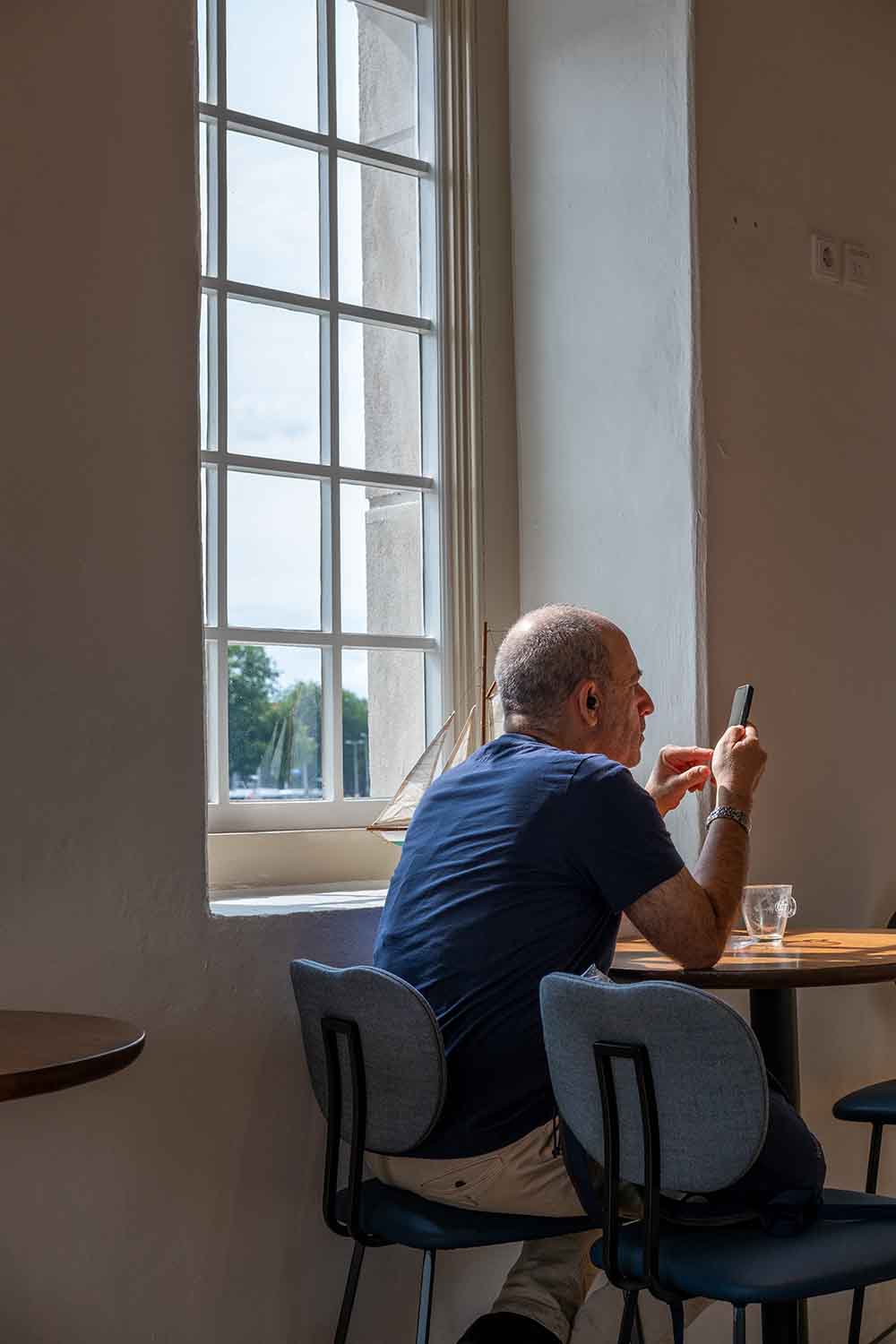
Any Early Portrait With The X-T50
Such nice light coming in from the window and what a nice window, tall and letting light in from above. And a pale, neutral colour on the wall. What is not to like as a setup?
This is the Fuji X-T50 with 35mm f2 lens, and I grew to like it as the days on holiday in Amsterdam wore on because I started to like what came out of the camera. To begin with I was shooting big scenes that were too far away to really show what the camera can do.
As I was reviewing the shots in the camera I began to see what was working.
I got the camera specifically as a carry-around and travel camera. I couldn’t put up with using my GRIII for everything because without a viewfinder, and in bright sunlight, I am shooting blind– or at least with less certainty.
In terms of image quality the X-T50 is of course ‘better’ than the GRIII because it has more pixels. But really it is just different.
Except I have to give it to the Fuji. For the shots that work, I like it more and after just a few weeks I developed a good feeling for it and started becoming attached to it as a tool.

Leave a comment