
This painting by Maximilien Luce (1858-1941) is of his friend Gustave Perrot, a painter and architectural gilder, getting dressed for work.
Luce was politically motivated – a member of the Anarchist Group in Paris – and specifically intended by his paintings to show that workers are people too, just as worthy of being treated with respect as any other subjects in paintings.
Is It Pointillism?
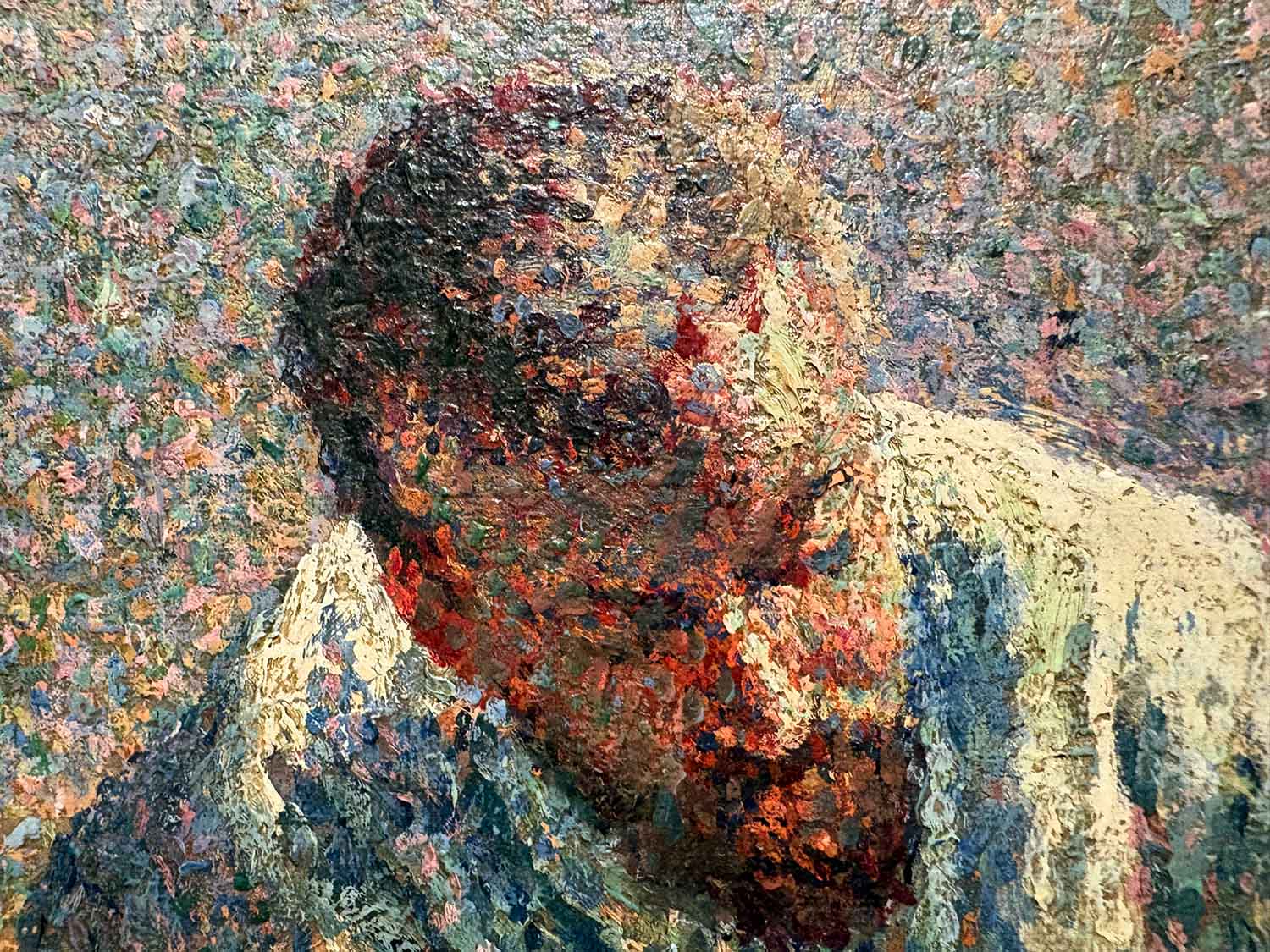
Viewed overall the painting certainly looks like a pointillist painting, with all those dots, wouldn’t you say?
But here are a couple of close-ups, and it looks like a lot of those are not dots at all, but splodges of colour mixed up together to the point that they are no longer discreet dots.
Well, there are dots, but not all over. And I get the point of the red dots to liven up the shadow under the man’s foot. But with all those splurges, when does pointillism edge back into Impressionism?
Ah, who cares? It is a painting whatever name is attached to the style. And yet the school of pointillism or Neo-Impressionism was trying to make a point about contrasting adjacent dots creating a new effect unseen in earlier styles.
But if you read about Luce you will read that “Luce was a strict Pointillist for many years, but his technique later evolved to a freer, more expressive style, especially after 1920.”
Maybe so but Luce painted this in 1890.
I kind of like that definitions fall apart in the face of actual facts, as in actual objects.

The Exhibition
The Pointillist exhibition is on until 8 February 2026 at the National Gallery in London, and this particular painting is on loan from The Metropolitan Museum of Art in New York. So if you are in London you could go see for yourself.
Here is another of Luce’s paintings. What stands out to me is that it is not a realistic painting of foundry workers. I say this not because it is stylised, which it is, but because from this huge cauldron of molten metal, a worker pours a tiny amount of molten metal into a tiny mould.
There is probably some technical explanation for it, like sampling the metal, but to me as an uninitiated viewer it does look odd, and bearing in mind Luce and others were anarchists, I wonder whether there is a message there?


Leave a comment