
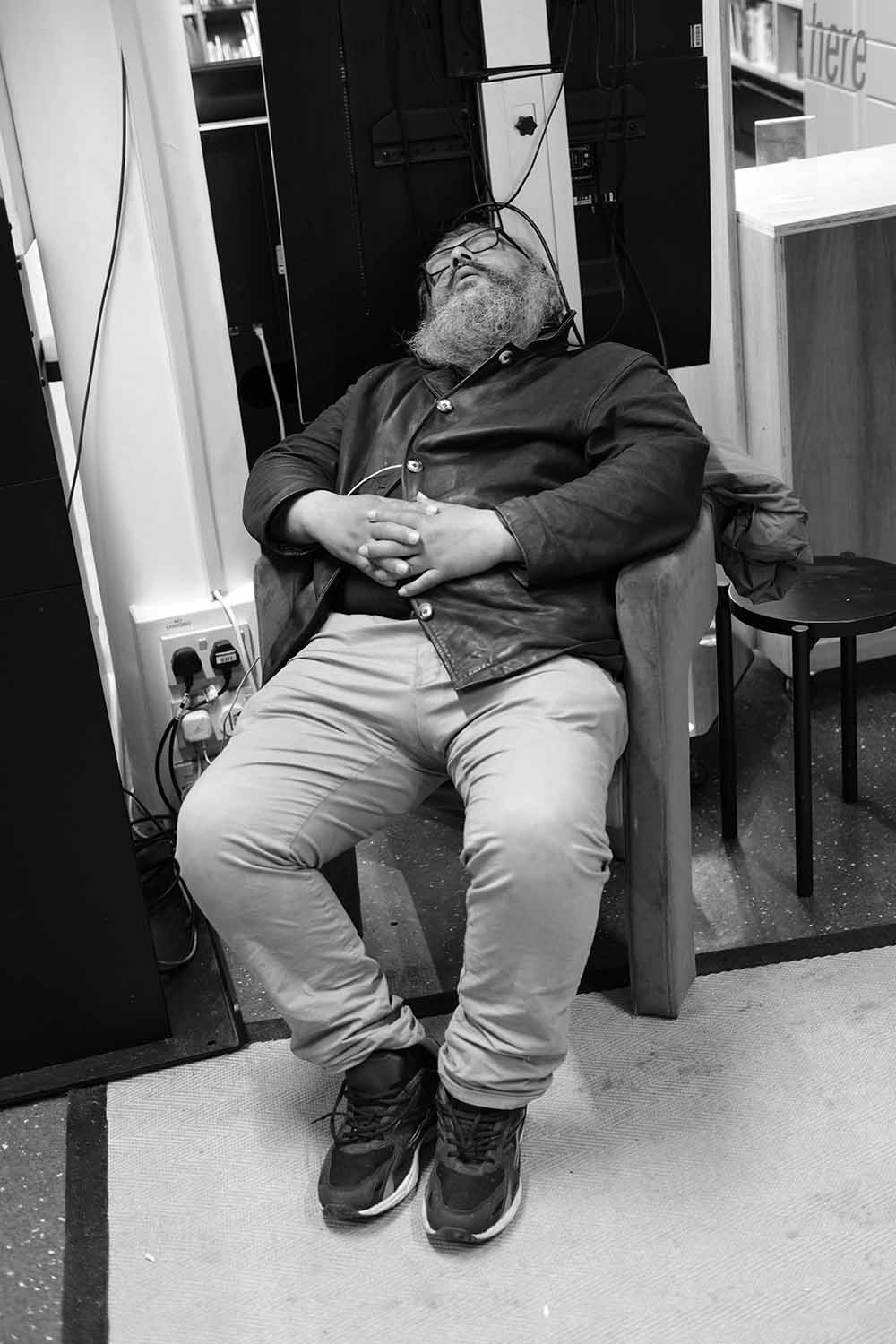
First, a man asleep in Charing Cross library in London.
And now to Giacomo Matteotti, an Italian politician who in 1924 stood up in Parliament and accused Mussolini of election fraud.
A few days later he was kidnapped and murdered on the orders of Mussolini.
In the library there is an exhibition explaining the kidnapping of Matteotti and its significance for European politics, arguing that the killing marked the ascendence of Italian fascism and led the way for the rise of Hitler.
Well, maybe.
The information sheets also state that one time the building was the UK headquarters of the Italian Fascist Party.
Who would have thought it?
Fascism in dear old England.
Well yes. In pre-war England there was Oswald Mosley’s British Union of Fascists.
Mosley was a former member of Parliament of both Labour and the Conservatives, and a member of the aristocracy. After becoming disillusioned with British politics he went to Italy to study fascism and returned to England and formed the British Union of Fascists.
They were known as the Blackshirts and they wore an armband with a lightning flash that were it not for its ugly meaning might make you think they were part of Ziggy Stardust’s band.
It’s funny because in 1927 he had mocked the fascists as black-shirted buffoons, making a cheap imitation of ice-cream sellers.
Ten years later he was a convinced fascist. Part of it might be that his modernisation plans were promoted by economists but rebuffed by the head of the Labour Party.
How many people becomes something they have earlier professed to hate?
Whatever the reason for his adopting the Blackshirt uniform, here is a story where Mosley went to see the senior politician Harold MacMillan to ask for advice about uniforms.
In his memoirs Julian Critchley tells how he later visited MacMillan and saw Mosley’s autobiography on the piano and asked MacMillan about Mosley.
MacMillan said that he told Mosley that the English have an abhorrence of uniforms and when they mean business they wear grey flannel trousers and tweed jackets.
The Battle of Cable Street in 1936 in London’s East End was a running fight in the streets when the British Union of Fascists decided to march specifically through a Jewish area in London.
The fight, between Mosley’s men and anti-fascists, local residents, trade unionists, and Jews was seen as a turning point of British people declaring their opposition to fascism.
When war broke out in 1939, Mosley was imprisoned and when he was released in 1943, he was disgraced and faded away, only to try again in the 1960s under a different guise of a united Europe. When that didn’t get anywhere he went to live in Ireland, where he died.
And not to stretch this narrative too much there is also Philip Roth’s The Plot Against America, about the rise and fading away of fascism in the USA.
I remember seeing photos of Lincoln Rockwell sitting at a meeting of the American Nazi Party in the 1960s with a nazi swastika on his sleeve. He was the leader of the party and there he was sitting as large as life, a neo-nazi, and I wondered about the United States that allowed nazism after the Second World War.
Now I understand how much freedom of expression is central to all that is America.
Rockwell was murdered in 1967 by one of the members of his party who was expelled following a disagreement about the aims of the party and an argument over the logos and style for the party.
The Conformist
When I read about Matteotti, I thought immediately of the film The Conformist . It is a brilliant Italian film from 1970. It is not about the assassination of Matteotti but rather of a socialist professor in 1930s Italy but it is so of the period that one can conjure up the feeling of the kidnapping and killing of Matteotti from the film.
There are so many good things to say about the film, but better than I can describe – Wikipedia says that in 2008, the film was included in the Italian Ministry of Cultural Heritage’s 100 Italian films that changed the collective memory of the country between 1942 and 1978.
In Charing Cross Road Library
A couple of days ago I set up the camera to capture a RAW image and a JPEG and I set the JPEG capture in the camera to FUJI ACROS, which is a black and white film simulation.
The RAW file is of course in colour.
Since I set up the FUJI ACROS black and white film simulation, the view I see in the viewfinder is in black and white.
I am experimenting with whether seeing the scene in black and white helps me understand the scene – any scene – better at the moment of taking the photo.
Below is the JPEG image straight out of the camera.
About the photo of the man asleep, he is obviously not homeless. His spectacles, his jacket say otherwise.
And is that a cable leading from inside his jacket and is he charging his phone?
Ah, to be that relaxed – as opposed to being worn out and beyond caring – that one can sleep in a public place stretched out like this.

Leave a comment