
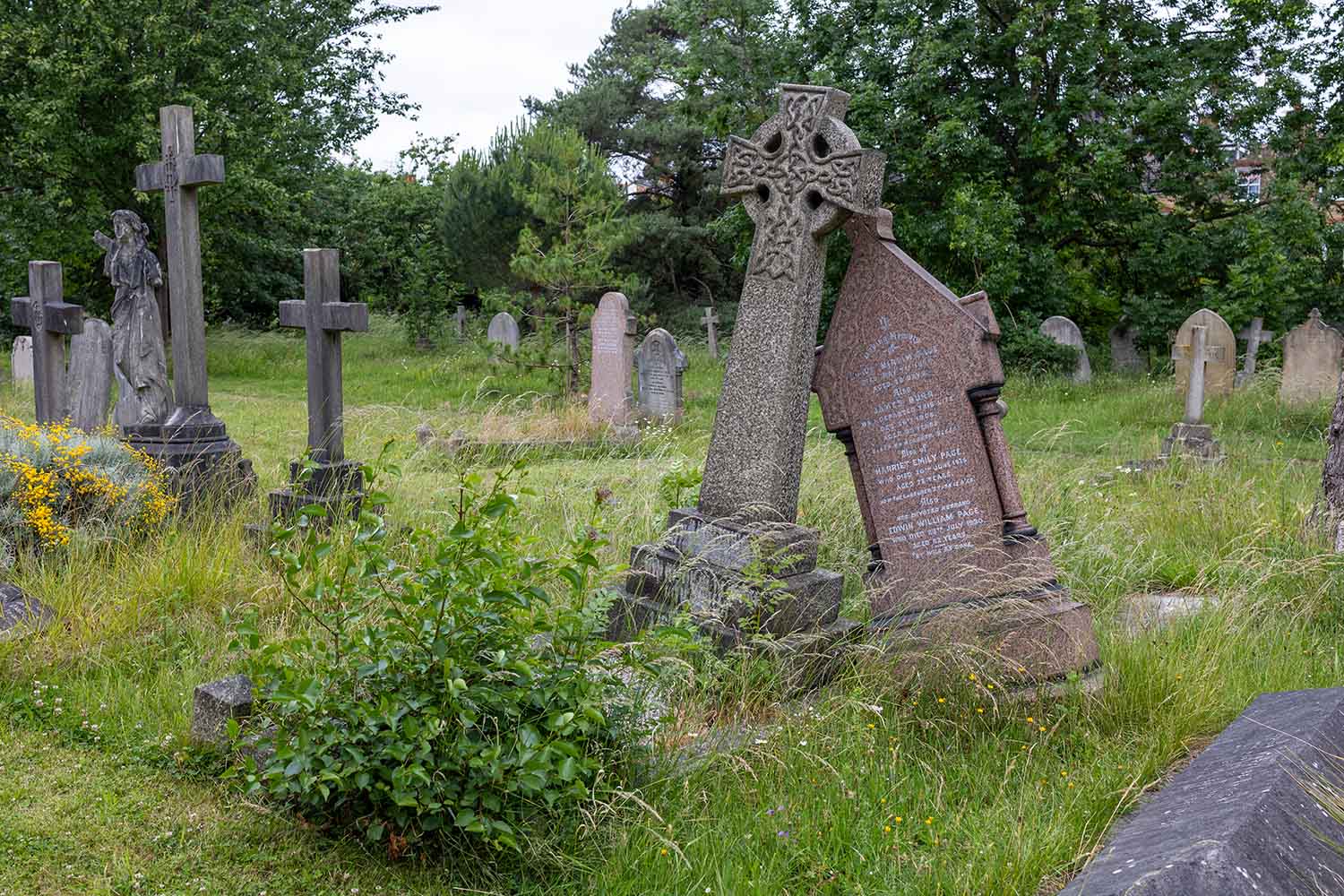
Old friends, known each other for years. leaning on each like gravestones in the Margravine Cemetery.
Oh, the sights they’ve seen, and the people they’ve seen. Snogging couples in the fading light, important people on their way to the hospital just past the gate and over the road.
And people just like me as I walked to the hospital to have my right elbow x-rayed.
From Barrons Court Tube Station, Google gave the best route going straight through the cemetery.
Who puts a cemetery next to a hospital or a hospital next to a cemetery?
And which came first, the cemetery or the hospital?
At first sight it seems Margravine Cemetery came first, in 1868, and the hospital in 1973. Although the hospital is modern-ish, I thought it might have been built on the site of an earlier building.
The earlier Charing Cross Hospital that dates back to 1823 but it was in central London near Charing Cross, just down from Trafalgar Square.
But then the Fulham Hospital was on the site before it merged with Charing Cross Hospital, and Fulham Hospital was previously the Fulham Parish Infirmary, built for inmates of Fulham Workhouse. A workhouse was an institution for those unable to look after themselves. And it was built in 1848 but for some reason didn’t open its doors until the 1880s.
So the infirmary and the cemetery came into being around the same time.
Still, whichever came first, the cemetery is a hop, skip, and a jump from the hospital, or vice versa.
But how many people are like me, wondering what the word margravine came from?
The term “margravine” originates from Middle Dutch, combining the word “marcgrave” (margrave) with the feminine suffix “-inne”. A margravine is the wife or widow of a margrave, or a woman who holds the rank of margrave. The margrave title itself comes from the German “Markgraf,” signifying a military governor of a border province, or a noble of equivalent rank to a marquis in other European peerages.
And how did that name come to be associated with and become the name for this cemetery?
Margravine Road, Margravine Gardens, and Margravine Cemetery take their name from Elizabeth Craven (née Berkeley), later Elizabeth, Margravine of Brandenburg-Ansbach-Bayreuth. Born in 1750, she was the daughter of Augustus Berkeley, 4th Earl of Berkeley, and Elizabeth Drax.
At sixteen, she married William Craven, later 6th Baron Craven, with whom she had seven children. The marriage was unhappy and both partners were unfaithful. After their separation in 1783, Elizabeth travelled widely across Europe, writing plays, memoirs, and a popular travelogue, A Journey through the Crimea to Constantinople (1789).
During her travels she formed a relationship with Christian Frederick Charles Alexander, Margrave of Brandenburg-Ansbach-Bayreuth.
Following the deaths of both their spouses in 1791, they married in Lisbon and settled in England, where they bought a house by the Thames in Hammersmith known as Brandenburg House. There they hosted plays and social gatherings.
Because of her notorious past, Elizabeth, now known as the Margravine of Brandenburg-Ansbach, was never accepted by London society or the court of George III.
After the Margrave’s death in 1806, Elizabeth moved to Naples, where she died in 1828.

Leave a comment