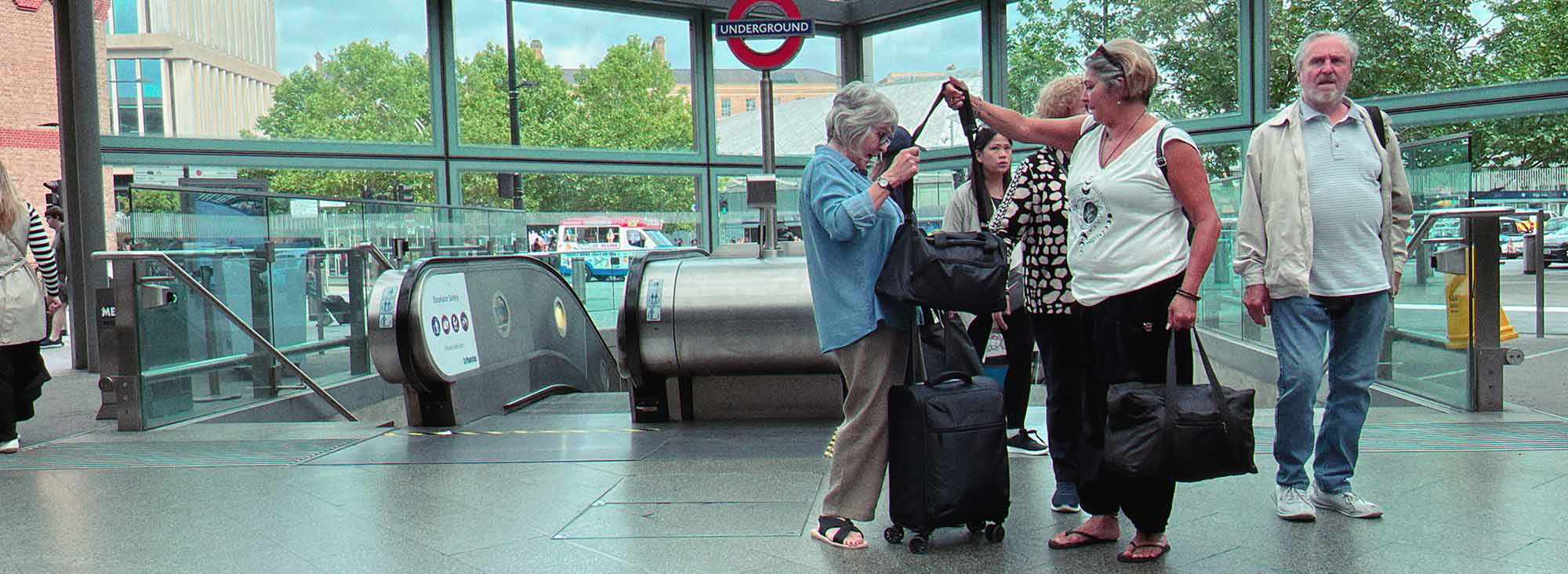
I like extreme aspect ratios because they are a surprise to the eye. They are not how we see but they seem to home in on the important action.
I shot this using the MOOD app on my iPhone 13mini. One of the MOOD app’s aspect ratios is 2.73:1. It does so by cropping the full frame of the sensor. But the iPhone’s 12MP sensor is tiny, so the image falls apart pretty quickly, as you can see here with the pixelation showing. It looks OK on a phone, but displayed on anything bigger it is showing its limitations.
A digital camera with a typical APS-C sensor size of around 24MP would allow cropping without this pixelation.
The later iPhones with more megapixels would be better but their sensors are still tiny.
So sensor size definitely allows for more cropping. But what about the number of pixels? By how much is a higher MP (megapixel) count better?
What Difference Does Pixel Count Make?
I’ll stick with Fuji for this article because they do a range of cameras with an APS-C sensor size of 24MP and 26MP.
And most recently they also make 40MP, APS-C sensor size cameras.
[They also make medium format cameras with even bigger sensors, but I am not looking at the Fuji medium format sensors for this article.]
What does 40MP give that 24 or 26MP doesn’t?
What is the difference in perceived sharpness and fine detail rendering between these MP counts?
Increased acuity reveals more texture and finer detail. It is most noticeable when making large prints, or with heavy cropping.
Cropping
A number of mirrorless cameras allow you to choose the image format in the camera. Any format you choose other than the format of the image sensor means cropping off some of the available pixels. That reduces image quality. But if you are starting with a 40MP camera then you have a lot of pixels you can throw away without reducing image quality too much.
MP are not really put to the test in portraits, because the elements (eyes, noses, mouths, etc are so large in the frame that the eye makes up detail easily.
It is most put to the test in subjects with fine detail such as in landscapes with lots of small leaves or grasses.
So what is the difference in perceived sharpness and fine detail rendering between a 40MP sensor (like in the Fuji X-H2 or X-T5 or X-T50) and a 24MP or 26MP sensor (like in the X-T3, X-T4, X-S10, or X-S20)?
A 24MP X-Trans III sensor is 6,000 x 4,000 pixels. An X-Trans IV sensor is 6240 x 4160 pixels. An X-Trans V sensor is 7728 x 5152 pixels.
Compared to the two smaller megapixel sensors, the X-Trans V sensor has 50% more area. But it is not area that determines extra sharpness. It is linear resolution that determines acuity. In other words, how much longer the longest side is, all other things being equal. And the 40MP sensor translates to approximately 33% more linear resolution.
In photography, acuity refers to the sharpness and clarity of an image, particularly in the details and fine edges. Acutance, a closely related term, describes the edge contrast and the perception of sharpness in an image.
In film photography, some chemical developers increase micro-contrast on edges and givve the viewer a perception of increased sharpness.
Sharpness tools in applications like Photoshop do a similar thing.
Anyone show has played with the sharpness sliders in Photoshop or Lightroom or any of the other tools knows that is possible to introduce a white halo around edges. If that is done carefully it can increase the apparent contrast between dark and light edges.
Either way, acuity and acutance are related to the ability of the human eye to see and compare the sharpness of different images.
After all, if the human eye can’t see the difference in acuity between a lower megapixel image and a higher megapixel sensor then there is no difference in practical terms.
So to repeat, increased acuity is most noticeable when making large prints, or with heavy cropping.
Oh yes, and then there’s the fact that lenses need to be able to resolve that detail.
The bottom line is that cropping a 2.73:1 image out of a frame from an APS-C camera with a 40MP sensor will give better results than an APS-C camera with a 24 or 26 MP sensor and hugely better than a similarly cropped image from an iPhone camera.
Ricoh GRIII
For comparison with image quality and how a larger sensor with a larger number of pixels holds together, here’s a crop from my 24MP Ricoh GRIII with the same aspect ration – and below that the image from my phone.
Click on the images to see bigger versions and you will see the difference even more so.


Leave a comment