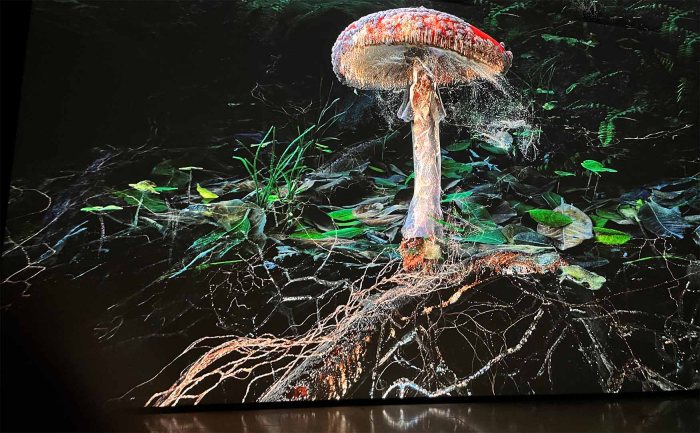
This is a photo of a photo of an Amanita muscaria, a mushroom commonly known as a Fly agaric. It is from the exhibition Soil: The World At Our Feet at Somerset House in London.
Amanita muscaria is poisonous, though not the most poisonous fungi by far. In times past it was dried and mixed with milk to kill flies, hence the name,
Merlin Sheldrake (author of Entangled Life) narrated the story of this fly mushroom and how it and the myriad other fungi send 13 billion tons of spores into the atmosphere each year.
The spores seed clouds and cause rain. They trigger processes in plants, plants that would simply die without fungi and the countless million threads that run through soil and connect plants, trees, forests. And there it is happening unseen in the soil.
How To Kill Land
Except that pesticides and herbicides can and have wiped out whole regions. Once the underground web is gone, the soil dies and the plants it supports also die. The soil turns to lifeless dirt and the winds blow it away.
Oh, they said. We didn’t know.
Entangled Life
The full title of the book is Entangled Life: How Fungi Make Our Worlds, Change Our Minds & Shape Our Futures. Here is a summary.
Fungi are underground, inside plants, and within our bodies. They form vast networks of mycelium that connect plants and trees, allowing them to share nutrients and communicate. These networks are sometimes called the ‘Wood Wide Web.’, and wherever they are they live in close relationships with plants, animals, and humans. These mycorrhiza or symbiotic association between a green plant and a fungus work by the plant making organic molecules by photosynthesis and supplying them to the fungus in the form of sugars or lipids, while the fungus supplies the plant with water and mineral nutrients, such as phosphorus, taken from the soil.
Sheldrake also explores how fungi can affect the human mind, including those with a potential to treat depression and other mental health conditions.
Fungi are also problem-solvers. They can break down pollutants, help create sustainable materials, and even provide new medicines. Some researchers are using fungi to develop alternatives to plastics and improve soil health in farming.
Finally, Sheldrake challenges the way we think about intelligence. Fungal networks can solve problems, adapt to their surroundings, and even “remember” past conditions—all without a brain.
Mycorrhiza Pronunciation
mycorrhiza: MY KOH RYE ZE

Leave a comment