Kings Parade

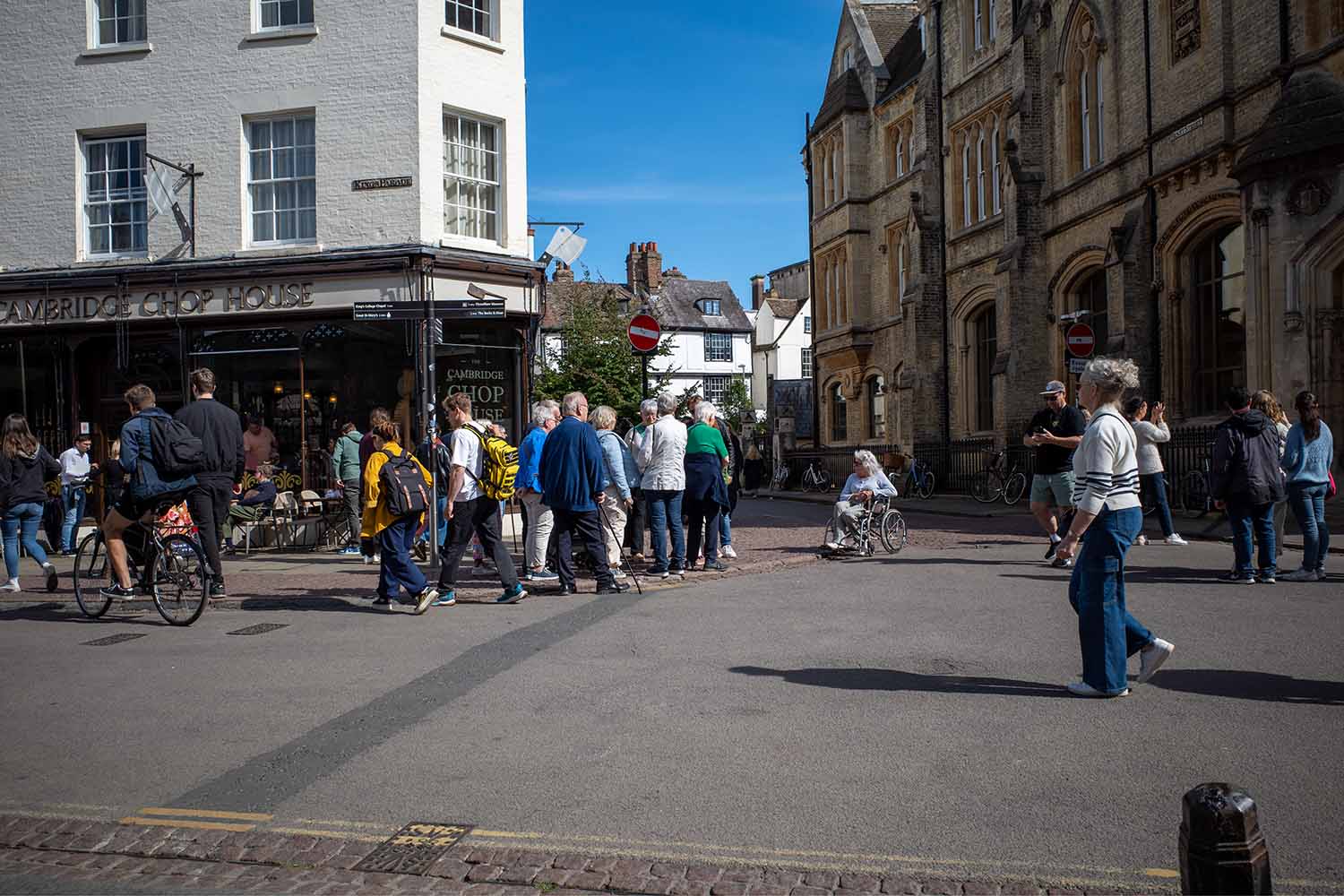
I’m guessing that the group of people are together, and maybe on a tour. Cambridge has many tours, and Kings Parade is a good destination.

Just down Bene’t street straight ahead is the church with the thousand year old tower. Behind me where I am sat on a wall, is Kings College with the chapel. It’s famous for its stained glass and for the music that is sometimes sent nationwide by the BBC Outside Broadcast. You see their big lorries parked up with cables snaking into the College..

Just to the right of the scene is the gold clock with the grasshopper escapement, a magnet for tourists. And behind me and to the right is the plaque to Alan Turing of Enigma fame.

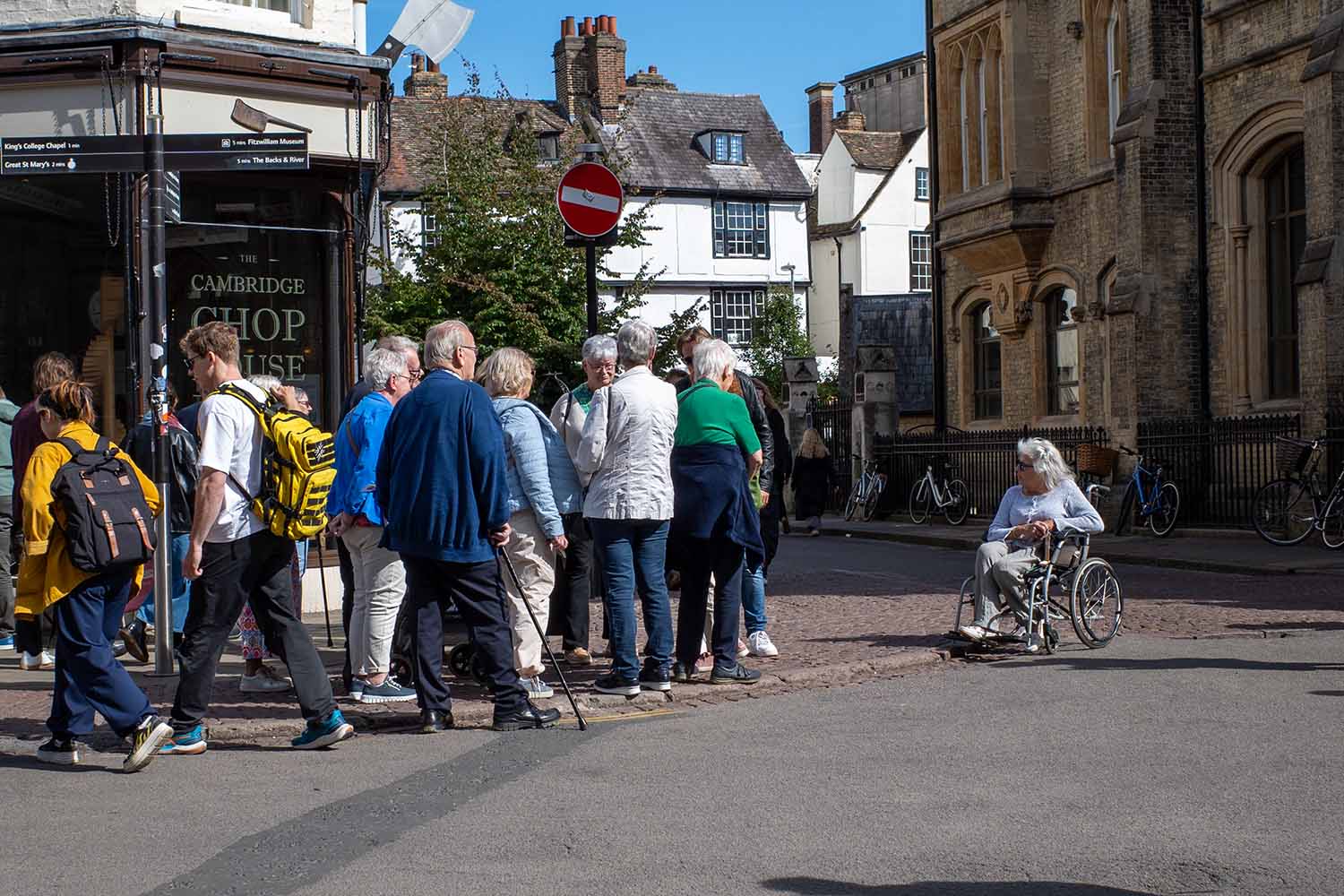
But what captured my eye was the woman in the wheelchair. A man wheeled her there and then walked off purposefully to the right. Is she part of the group? Does anyone realise she is on the road and not the pavement?

Click the photo to see it bigger.

Discover more from Photograph Works

Subscribe to get the latest posts sent to your email.

Comments

15 responses to “Kings Parade”

  1. Nice summary of the King’s Parade area and history — and good observation about the woman in the wheelchair just seemingly plopped down there in the middle of the road: Yikes!

    Liked by 1 person

    1. Plopped is a good word for it.

      Liked by 1 person

  2. I’m thinking that it’s just easier to manoeuvre her on the asphalt of the paved street than on the cobbled sidewalk? That and he’s actually ‘parked’ her right at the very edge of the curbing dividing one and the other…

    Liked by 1 person

    1. That, and it very likely also makes for a much more comfortable ride for her as well… (Rather than the spine-jolting, tooth-rattling ride in wheelchairs that have absolutely ZERO suspension to compensate for such things :/)

      Like

      1. I’ll give you that. The pavement is not cobbled, just the kerb edge. But having once done an exercise with students testing how wheelchair friendly the world is, I know how what might seem to able bodied people to be a minor dip is a major obstacle for chairs.

        Liked by 1 person

        1. Perspective & empathy…
          We must be taught these things
          Oh wait! “Do unto others as you would have them do unto you”. All societies have their own version of this, it is in our very bones…

          Like

          1. Do unto others as you would have them do unto you, is not in my tradition. In my tradition it goes “Do not do unto another that which is hateful to you. The rest is commentary, go and learn.” (Hillel the Elder)

            And there is a world of difference between the two.

            But yes, it starts with education. It’s the only hope

            Like

            1. It’s now 24.09.17 and here we are again David, in much more depth this time, but previously discussed back on 23.11.23

              Ancient language translation is not an exact science and often differences arise, particularly where there are multiple possibilities dependant on phrasing and context; even more so when you consider this effect has been multiplied each time a translation has been done.
              But, even though the idea is written in different languages and having morphed over time, the basic idea remains the same and that, semantics aside, we (all of humanity) believe in this same concept.

              It has always struck me when these discussions have arisen (with many people whose customs originate from different places and are of many religious backgrounds) that there are more similarities than differences between our beliefs when quoted yet another version of the Golden Rule.

              This morning I started to look for examples for you…
              Taoism: “Regard your neighbor’s gain as your own gain and your neighbor’s loss as your own loss.”
              “This is the sum of the Dharma [duty]: do naught unto others which would cause you pain if done to you.”

              I vividly recall when a co-worker shared their copy of The New York Times shortly after September 11, 2001, and reading an article on this very subject; it being passed from hand to hand and the discussion which ensued with so many people after we’d read it.

              Many years later, when this subject had arisen again, I came across a poster illustrating this same concept we’d discussed all those years ago (and many times again in the interim).

              But this morning, while pulling articles for my response to you [and the quotes cited above], I found this piece from 2002 on the history of this same poster, and suddenly realised it may have been the source of that New York Times article which had such an impact on me over two decades ago and it originated barely 100km away from where I sit writing to you…
              https://www.scarboromissions.ca/golden-rule/the-golden-rule-poster-a-history

              Like

              1. Thank you for giving time to this, which is plainly important to you as it is to me.

                How to unpick it and tell you how I see it? This analysis was told to me nearly thirty years ago and it has stayed with me. I see it as two arrows that seem to deviate by a hair’s breadth at the origin but end on very different targets.

                Let’s say a person has a truth and follows the rule ‘Do unto others as you would be done by’. The natural outcome would be to share that truth to others who do not have that truth. This is the proselytising. It is the justification for ‘educating the natives’.

                Now take the opposite rule ‘Do not do unto another that which is hateful to you.’ – now the whole field is open and when two people meet, and each abides by the rule, then the interaction is between two meeting as equals who investigate one other.

                Liked by 1 person

                1. For ALL of my life David, I have had issues with those who (am paraphrasing you slightly, sorry): use these words as the “proselytising justification for ‘educating the natives’“ and rejecting the pomposity of anyone who feels their beliefs are “the Only Way” and “it’s my way or the highway”; or the patriarchal “Do as I say, not as I do” and “Why? Because I say so!” when the original intent – and the very heart of all of these Teachings – is to simply do the right thing?

                  The trick for all of us is to maintain focus on that original intent: to teach by the example we set and actually “walk the walk, not just talk the talk”; to be aware, question and truly see how it’s been twisted to suit those who would use it for their own purposes – most often greed and power.

                  Liked by 1 person

                  1. That’s heartwarming.

                    Like

    2. The thing is that Bene’t street is narrow and believe me, a car coming up the street would pass very close to where she is. Also cars and vans come up Kings Parade (from the right in this photo), and cannot go down Bene’t Street (see the No Entry sign) and they cannot continue on Kings Parade because there is a barrier (just to the left in this photo) – so they have to turn around. And she is just perfectly placed to be swiped.

      Like

      1. I am not attempting to justify the man(her Caretaker?)’s actions, only suss out the logic for his having done so…. If these people are a group of tourists (odds are) then the frustration of attempting to keep up with the herd whilst pushing a wheelchair and attending to the person in it may be his only focus? Or mayhap he forgot something back at their vehicle, needed to use the facilities, could be a dozen different things or have no thought process attached at all?
        (Logical thinking seems to be in short supply these days… ; )

        Like

        1. Yes, there could be any number of reasons – and some will be good reasons. Maybe he was certain one of the group would eases her onto the pavement.

          Like

      2. Not having been there to actually observe what was happening at the time (and having never been there in person) I am forced to draw conclusions from the details I can observe from the photograph.

        Like

Leave a comment

This site uses Akismet to reduce spam. Learn how your comment data is processed.

Discover more from Photograph Works

Subscribe now to keep reading and get access to the full archive.

Continue reading