Black Atlantic is the name of an exhibition just ending at the Fitzwilliam Museum in Cambridge UK.
It’s a kind of a mea culpa because a slave owner gave Cambridge University the money to build the museum. He made his money from pineapples in the Caribbean – and used slave labour to run his business.
Twelve and a half million people were transported to the New World to make money for the European entrepreneurs, often with State backing and with scientific connivance concluding that Blacks were lower in the brains department, and less human.
Ten million seven hundred thousand arrived, so almost two million died on the way.
One exhibit caught my eyes – a punch bowl from the 1760s with a motif proclaiming ‘Success to the Africa Trade’, and celebrating the voyages of George Dickinson.
I photographed part of the bowl by resting my phone on the top of the glass case in which the bowl was displayed.
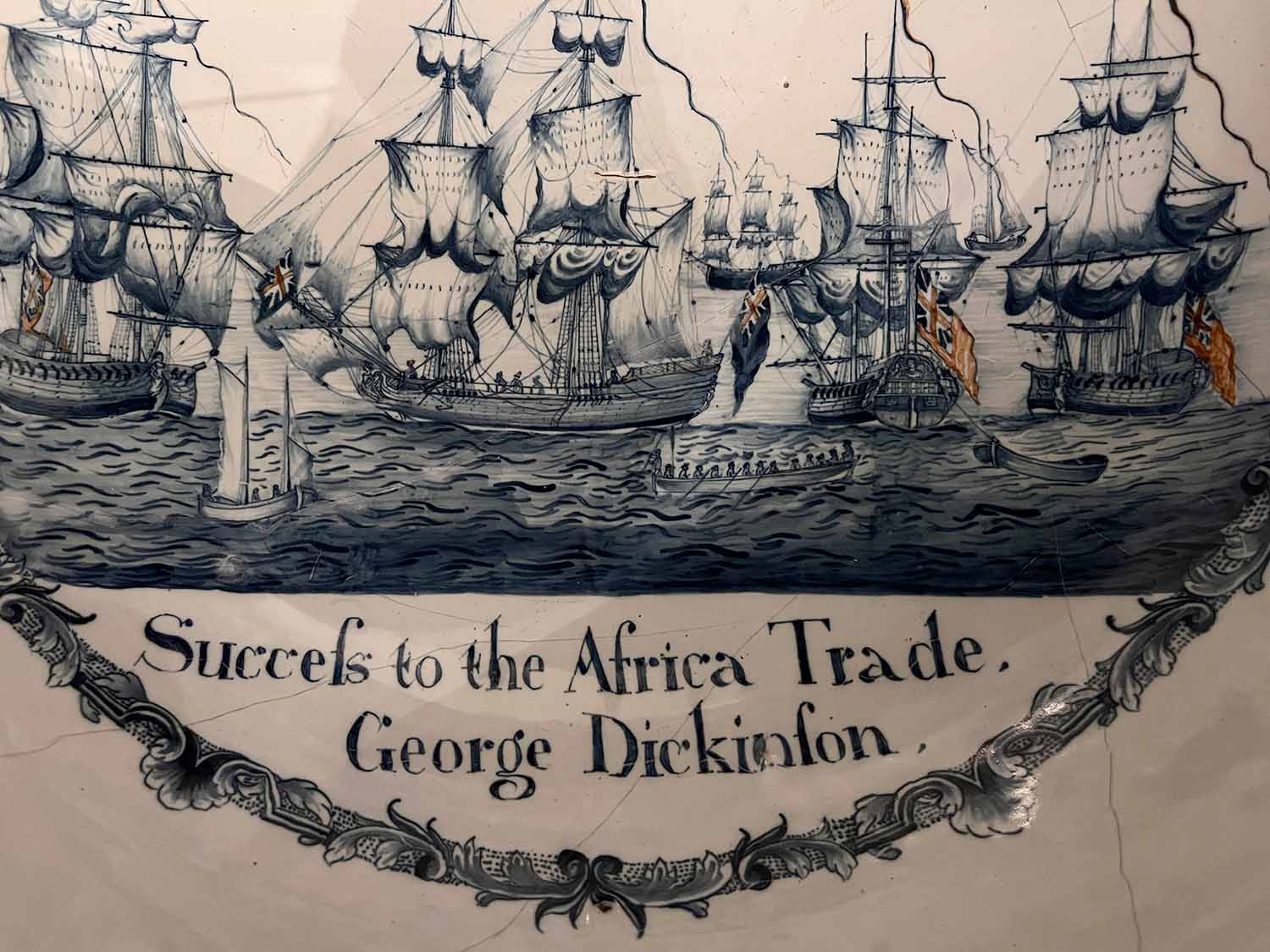
Dickinson made five voyages on three ships, between 1763 and 1768, transporting a total of 725 captives across the Atlantic: 97 died.
I am going to assume the numbers are typical for all voyages. In that case 725 divided by five voyages is 145 slaves.
Twelve and a half million slaves at 145 per voyage equates to over 86,000 voyages.
After Seeing The Exhibition
I wanted to resist tutt-tutting at the terrible deeds. I had to work to keep my own feelings and not be swept along with the tide of feelings that are kind of expected in a mea culpa exhibition.
So many stories, so many strands. We should be educated; I have little doubt about that.
How should we feel? I am part of a minority that has been everywhere up and down the social and economic ladder or hierarchy. How should dyed in the wool white English people feel? Many of them will have great grandparents who lived miserable toil-filled lives. They too have their stories.
In a place like Cambridge there will be more than a sprinkling of people who come from privileged families. Perhaps they will feel uncomfortable? Should they feel more uncomfortable than the poor? People from poor backgrounds might feel they are off the hook.
The truth is that if the profits were kept by the wealthy, they didn’t conduct the slave trade all by themselves. There would have been people from every class without whom the system would have ground to a halt immediately.
How quickly did the racial stereotypes filter into the way everybody from the top to the bottom felt about Black people?
And today should ‘we’ be making amends? And how? Exhibitions don’t pay the bills, even if they do raise awareness. And if, as it was, that the whole system was driven by money, then should ‘we’ pay money back?
And if so then how much? Europe took off like a rocket on the back of the profits from the slave trade.
What about all the compounded benefits? Should there be a discount because the world would not be in the happy place it is without the initial capital that drove technological advances in which everyone can now share? And who is ‘we’? Aren’t we all the same – give anyone any excuse and wouldn’t we do the same? Or would we? Not now, today of course, but under the influence of the environment prevailing then. Of course we would not be cruel – but that seems a poor excuse for turning human beings into energy sources against their will.
And what about the intermediaries, the North African traders, the tribe-on-tribe enslavement? How would we allocate responsibility?
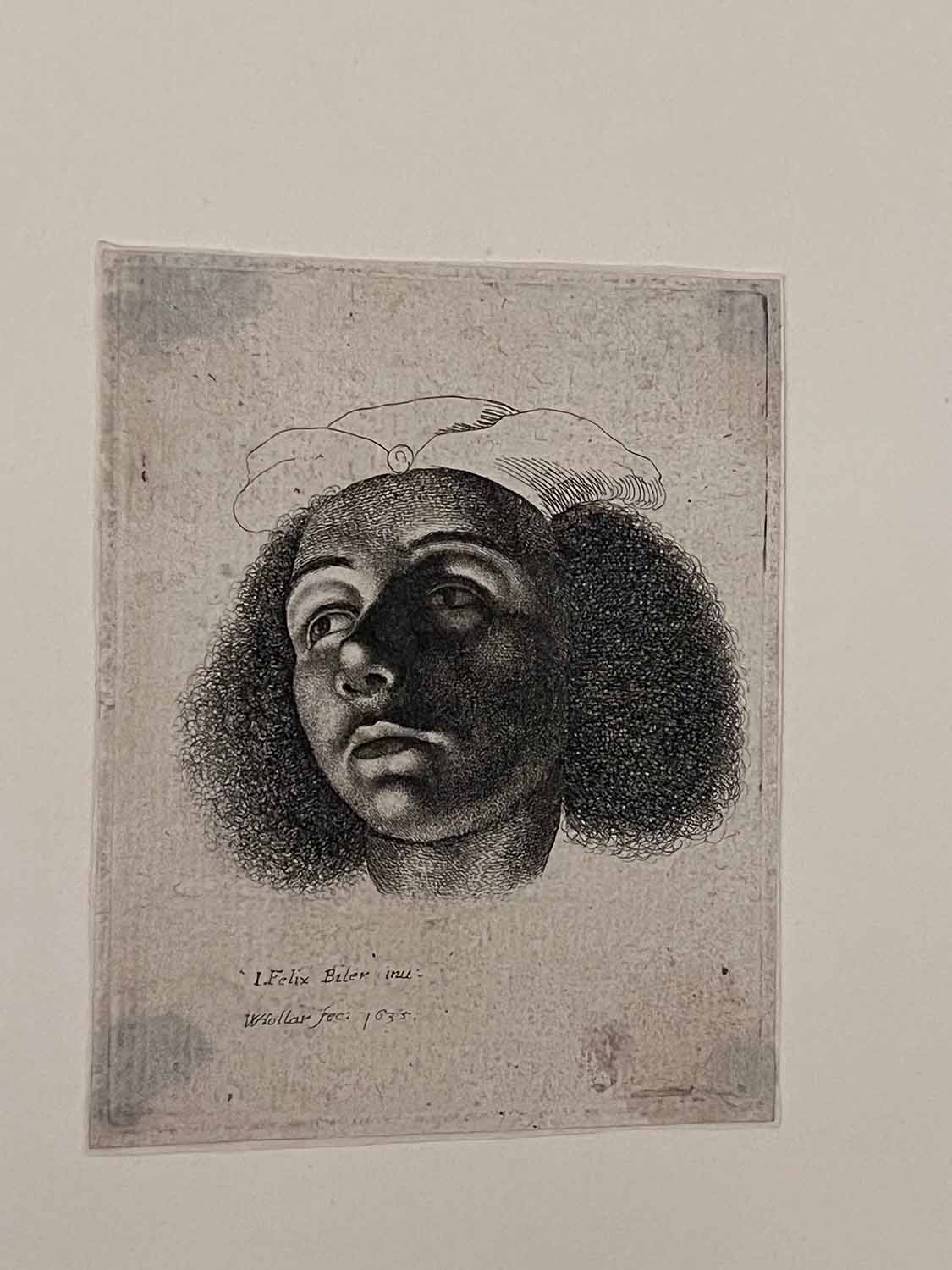
Maybe we have moved on. Here is a young woman at the exhibition, and behind me from the vantage point from which I photographed the three women, is a drawing in a book from the slave period.
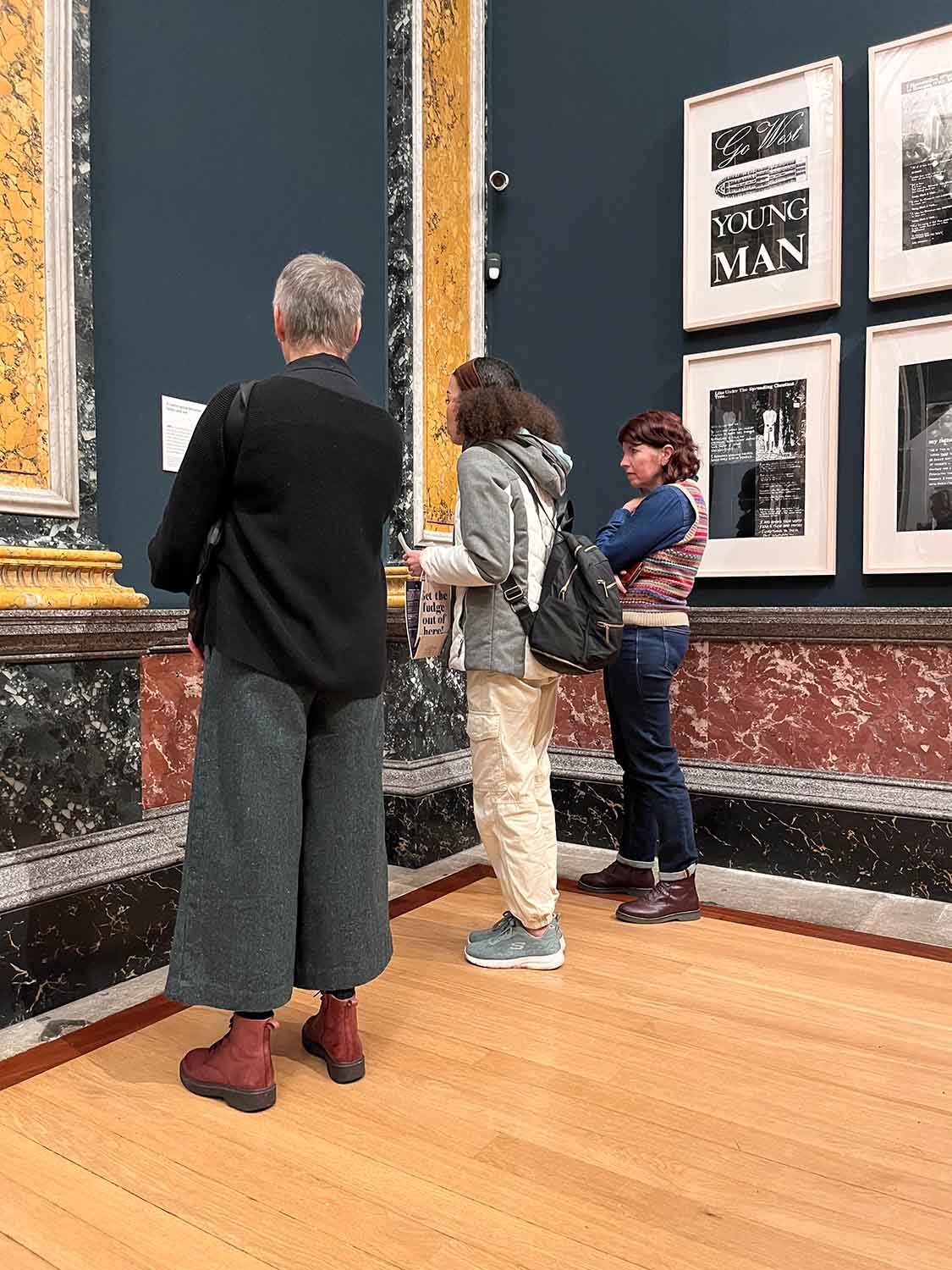
Do you see the similarity in the hairstyle?
Audubon and the Spoonbill
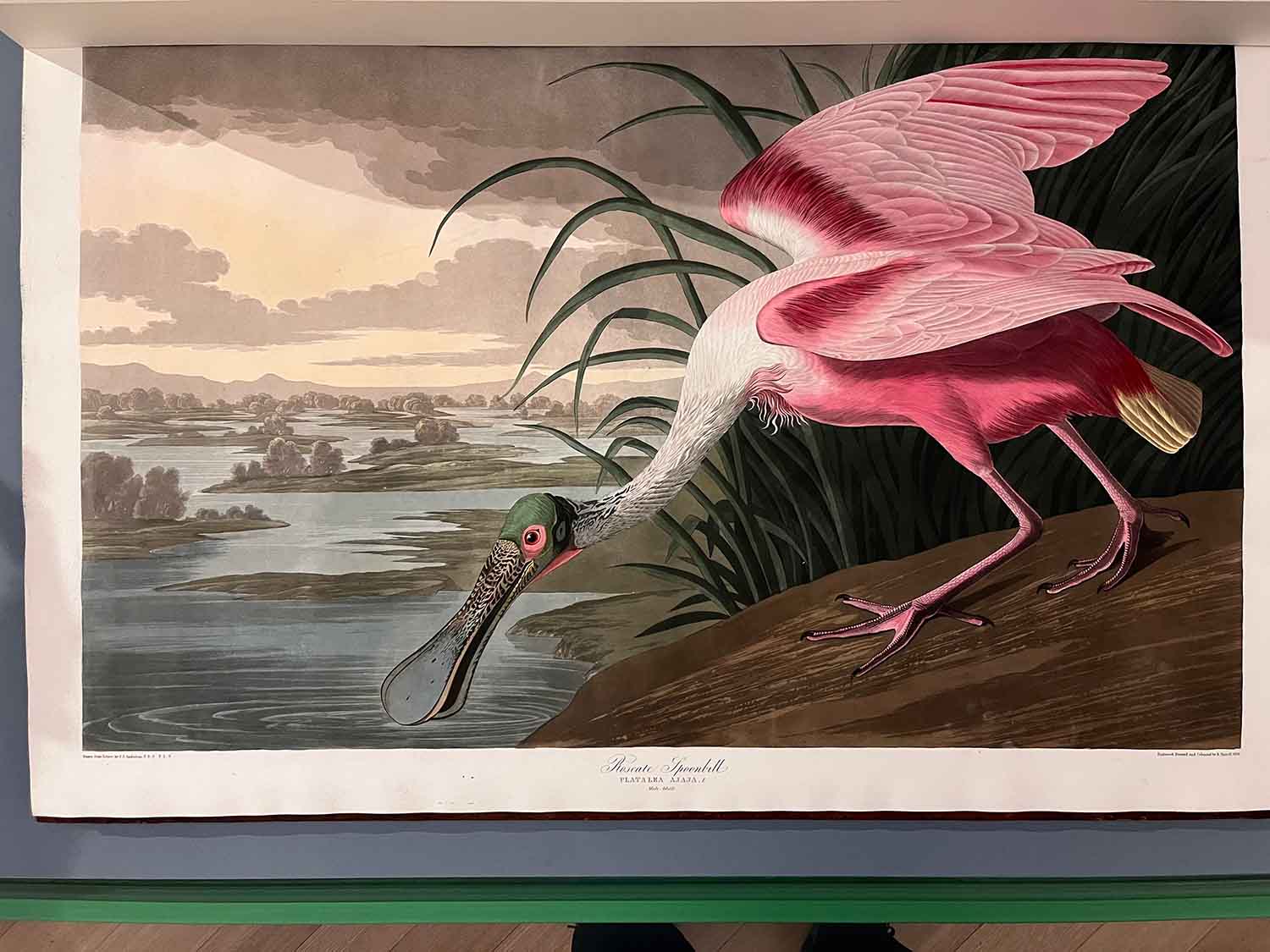
From the Black Atlantic exhibition, accompanying the spoonbill illustration
“The Spoonbill’s wing
1831 The spoonbill’s wing stretches towards the picture plane, so close we can almost touch it.
According to naturalist and artist John James Audubon, the spoonbill’s wing and tail feathers are ‘manufactured into fans by the Indians and Negroes of Florida’. Despite using their ornithological skills and knowledge, Audubon never credits AfricanAmerican or Indigenous people in his ‘Birds of America’, which is paid in part by a subscription from The Syndics of the Fitzwilliam Museum, following his visit to Cambridge in 1828.John James Audubon (1785-1851) ‘Birds of America’, 4 volumes (1827-38) Volume 4 open on plate 321 (Roseate spoonbill) Fitzwilliam Museum, University of Cambridge: PB 4-2021 Acquired via a subscription taken by Vice-Chancellor Martin Davy (1763-1839) after Audubon’s visit to Cambridge in 1828″
The thing is that now today, groups are excising the name Audubon because he “did despicable things” and supported his work by buying and selling slaves — and that’s according to the organisation that bears his name
The Audubon Naturalist Society is now called Nature Forward. Others planning similar moves include Seattle Audubon, Chicago Audubon and Portland Audubon. In some cases, they’ve put a slash mark through Audubon’s name where it appears on their websites.
Further Thoughts About Audubon
I can see how, if the oppression was still going on, that descendants of the oppressed would want to get rid of a name that was an open sore . That’s an emotional response.
If on the other hand, everyone was now equally regarded, then maybe I would ask why go pulling at old scabs that are now just curiosities, rather let’s just carry on getting on together.
But if the injustices were still going on, then I am suspicious of those who are inheritors of the oppressors, who want to ‘right the wrong’ by changing a name. It’s just too easy. Like I said, show us the money and I will reconsider.

Leave a comment