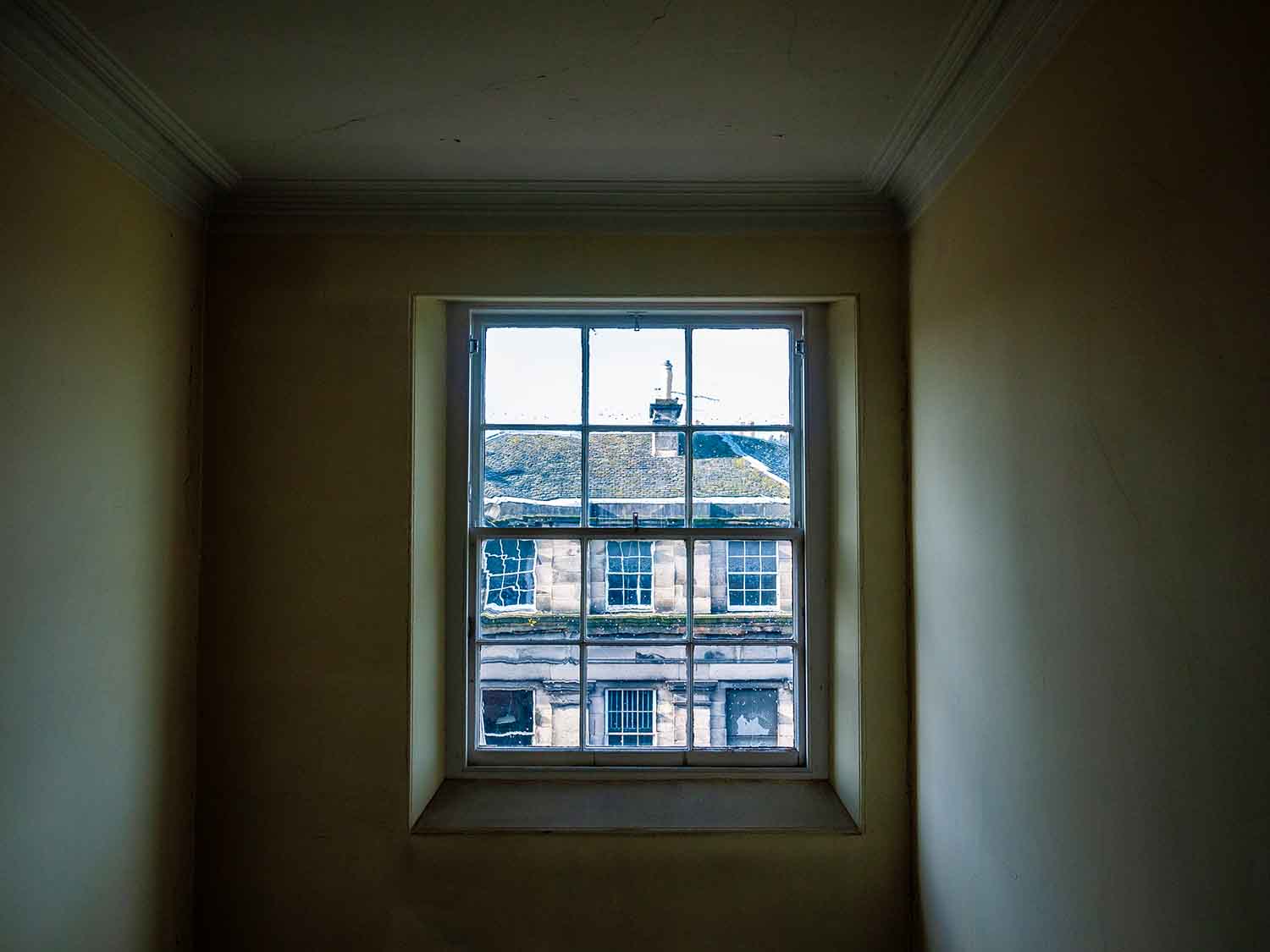
Glass is a supercooled liquid. I remember that fact from my school days. Some glass is so soft that over time it drips slowly. A window pane that started off even in thickness eventually becomes a little thicker at the bottom as the glass flows downwards under the effect of gravity.
Nowadays, sheet glass is made by rolling molten glass between steel rollers. Before that technology was available, sheet glass was made by dropping a large blob of molten glass from a height onto a flat bed of metal. The glass flows outwards and cools, and then it is cut into panes.
Sometimes the metal bed was rotated at speed and as it spun around it caused the molten glass to spread further outwards
The glass would be thicker directly under where is was dropped from and you have probably seen glass panes with a little thickened blob in them. They were the cheapest panes.
Later, panes with bullseyes became fashionable, and were sometimes specially made, even when rolled glass was available. You see them in ‘Ye Old Sweet Shop’ and ‘Ye Old Cafe’ in some towns in England, although I rarely see them now. Perhaps they have gone out of fashion.
In small glass works, glass sheets were made by spinning a blob of molten glass on the end of a rod of steel held horizontally. The blob spins outward and forms a disc from which a panes could be cut. And the central pane would have a bump in the middle where it was attached to the rod.
Sheet glass made by dropping a large blob of molten glass from a height was never flat in the same way that modern glass is. And it was softer. That’s what’s caused the distortion you can see in the view of the buildings across the street seen out of the window.
The Photo
I shot this ages ago with a little Panasonic GF1 with a 20mm lens. The sensor on the GF1 is micro four thirds. The full frame equivalent is 40mm. That means that the view in this photo is a perspective more or less like our eyes see.
I don’t know about the colour because one of the reasons I didn’t keep the camera is because it had a slight colour shift, unlike Olympus, Nikon, and Fuji which all have their own characteristics but must closer to what we see in reality. I remember the little Panasonic shot more acurately in subdued even light, and the cold colour shift was most noticeable in bright sunlight.
I shot this in Edinburgh, and I remember taking it and being in this room which was empty of furniture or decoration. But why was I there at all? I think I was there with Tamara, and that’s it. Lost in the mists of time. I love that, that some things are lost.

Leave a comment