
This is Richmond Bridge, built in 1777, the oldest bridge across the Thames. When it was built it was a toll bridge, and the tolls repaid the investors, who invested their money as a tontine.
A tontine is a kind of a lottery where the last man alive takes the lot. Each year after the bridge was completed, the members of the tontine split the proceeds from the tolls. Then as one man after another died, their shares were split among the remaining members of the tontine, and so on.
The last man outlived his fellows by several years, and collected all the tolls as his reward.
If you are familiar with English law you might know that specific Acts of Parliament to deal with specific circumstances were once much more commonplace than they are today.
The Richmond Bridge Act of 1772 is an example of an Act specifically to do with the proposed Richmond Bridge.
The interesting thing is not just that it authorised the building of the bridge, but also that it established a sentence of transportation to the colonies for seven years for anyone vandalising the bridge.
It’s an interesting thought as to which of the ‘colonies’ a person might be sent to. The American wars of independence started in 1775, and no convicts were sent there after the start of the war. And Britain’s colonisation of Australia begain in 1778 after Cook landed there in 1770 and transportation didn’t start until 1787.
So if someone vandalised the bridge in 1780, they would have had to have been sent to the British colonies in the West Indies, which are:
Anguilla, the Cayman Islands, Turks and Caicos Islands, Montserrat, the British Virgin Islands, Antigua and Barbuda, The Bahamas, Barbados, Dominica, Grenada, Jamaica, Saint Kitts and Nevis, Saint Lucia, Saint Vincent and the Grenadines.
The British Virgin Islands is of course in the news now as the place where almost one half of the providers found in the Pandora Papers have acted as registered agents for over 370,000 companies hiding secret wealth.
All this hidden wealth was speculation until the Pandora papers – 11.9 million records from 14 different offshore service firms – made its way recently to a consortium of investigative journalists. Now, a ragbag of politicians and others are in the spotlight for stashing their wealth offshore.
And of course the big question is from where did their wealth derive when there is no obvious answer to how they acquired it.
Back To The Bridge
Before the bridge there was a ferry. And on one bank the land rose steeply and limited the traffic the ferry could handle. The traffic off the ferry couldn’t negotiate the incline on that side.
The bridge was designed to overcome that, because traffic would come off the bridge at a higher point than the river bank. That didn’t quite work out because the landowner on that side wouldn’t give up part of her land for the road. So the bridge had to swing in a curve around the landowner’s land to get up the hill.
Of course, that was then, and nowadays cars and buses chug straight up the hill without a thought.
Still, the bit where traffic came off the bridge on that side was steep. Then, in 1937, the bridge was widened and flattened, as I knew that from reading about it beforehand.
So when I was standing by the river looking up, I saw what I think must be the line of the bridge before it was flattened, following the colonades as you can see in the photo here.
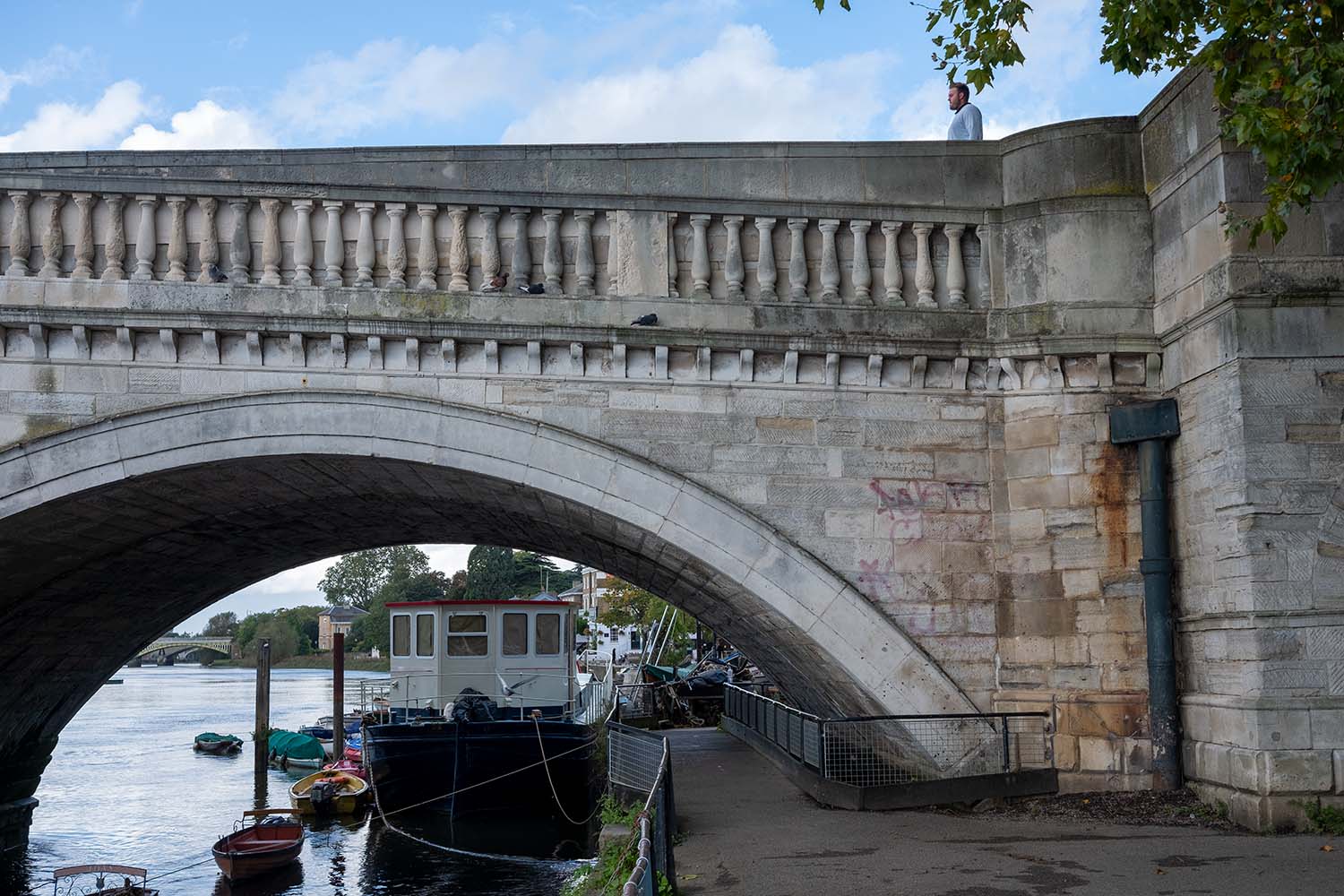
If you travel up the hill and turn right at the T junction and travel on, the road rises more and more. Eventually you are on Richmond Hill and then at the entrance to Richmond Park. (See my earlier posts about the park and the deer in the park.)
Just a bit further from the bridge and on the same bank, were canoes tied up along the river, framed by trees and the river bank.
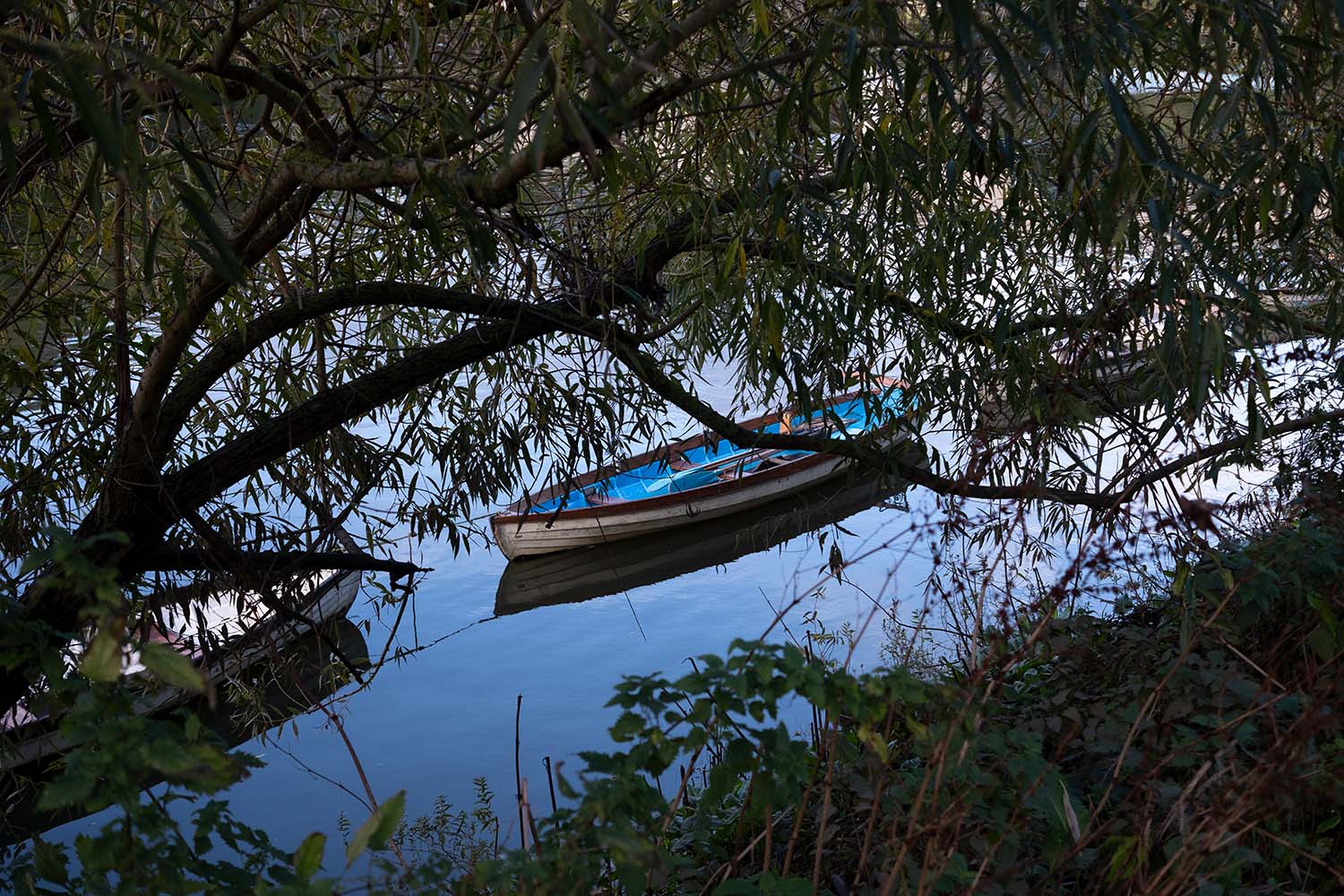
Click any of the photos for bigger versions.

Leave a comment