If you shoot with a digital camera, there is a light meter built into it and you don’t need another one.
If you shoot with a reasonably recent film camera, it will have a light meter built in to it.
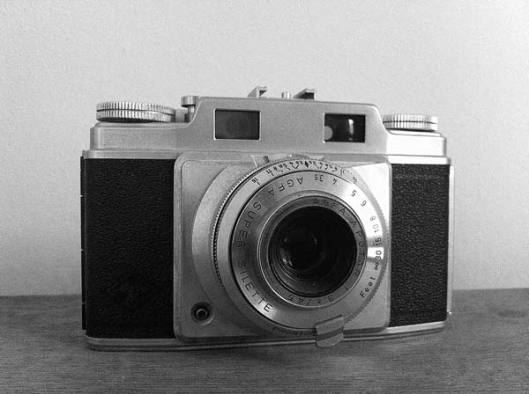
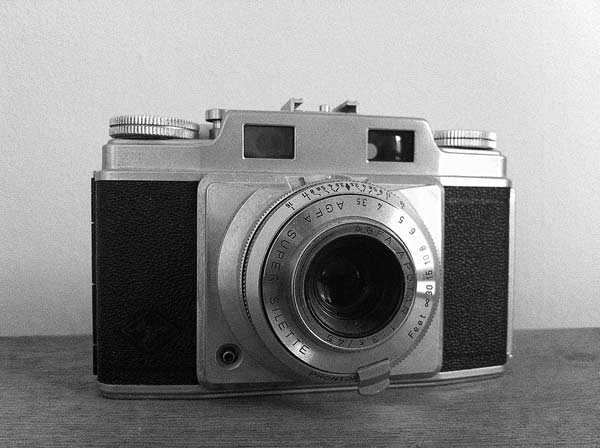
This camera (The Agfa Super Silette) is a fairly advanced camera for its day because it is a rangefinder camera.
The way the rangefinder works is by having two images – one over the other – in the viewfinder.
You turn the lever on the lens and when the two images appear correctly superimposed so you just see one image, the camera is in focus for what you are looking at.
But what this camera does not have is a light meter.
If you have an old camera like this that doesn’t have a light meter, but you have your digital camera with you – then you can use the readings from the digital camera to set the aperture and speed on the film camera.
Or you might even have a dedicated light meter.
I have one. I bought it some years ago to use as a flash meter for when I used to shoot film. It is a dual-purpose meter that can measure the output from a flash head and also measure ambient light.
But let’s suppose you don’t have any of these gizmos, but you do have your old camera with no light meter – and an iPhone.
Well then you are in luck because there is app for that – as the saying goes. (There is probably an app for Android phones as well, but I have an iPhone, so I am going to stick with describing that.)
It’s called the pocket light meter and it is available free (or paid for, if you don’t want the ads on the screen) from the iTunes store.
This is what the app looks like focused rather shakily on a door knob. You can see that the light is low because it recommends a shutter speed of 1/3 second at ISO 800 and an aperture of f5.0. I could have spun any of the dials to get the corresponding result.
For example, I could have opened up the aperture to f2.0 and that would have given me a faster shutter speed.
The app doesn’t actually take a photograph: It just gives you the readings for use in your old camera.
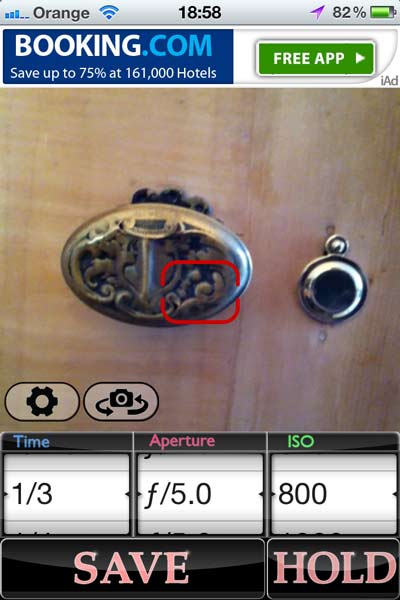
The advertisement looks rather dominant here in the screen-grab. But it’s easy to ignore it when using the app.
The Super Silette
The Super Silette is an interesting camera because of the lens. If I remember correctly, the Apotar lens, as it is called, is built on a Tessar design.
This is a very compact lens design and gives a nicely rounded look to images. What I mean is that when I photograph people with it, the sides of the faces ‘retreat’ in a very pleasing and rounded way giving the whole image an extra three-dimensional look.
I have some Fuji Reala color print film loaded into the camera at the moment, but I don’t know when I will get around to shooting it because my digital camera keeps calling to me to take it out instead….

Leave a comment